Exotic Hawaiian flowers are the bold tropical blooms that fill Hawaii’s gardens, flower farms, lei stands and weddings. Most of them are not native to the islands. They arrived over the last two centuries from South Africa, Southeast Asia, South and Central America and Mexico, carried by botanists, missionaries’ families, the University of Hawaiʻi and flower growers, and they found a perfect home in Hawaii’s warm sun, rich volcanic soil and gentle rain. A few, like the yellow hibiscus maʻo hau hele, are true Hawaiians that grew here long before people arrived.
This page tells the story of the flowers on our tropical wedding flowers page: where each one comes from, how it reached Hawaii and how it is used today. It is a living page, and we will keep adding to it.
They came on sailing ships and in botanists’ satchels, from the Cape of Africa, the rainforests of the Americas and the islands of Asia. In Hawaii’s sun and rain they bloomed as if they had always belonged here.
At a glance
| Flower | Scientific name | Family | Native to | In Hawaii since |
|---|---|---|---|---|
| King protea | Protea cynaroides | Proteaceae | South Africa | 1960s (Kula, Maui) |
| Torch ginger | Etlingera elatior | Zingiberaceae | Southeast Asia | Introduced; grown on farms |
| Red ginger | Alpinia purpurata | Zingiberaceae | Southeast Asia and the Pacific | Introduced; widespread in gardens |
| Anthurium | Anthurium andraeanum | Araceae | Colombia and Ecuador | 1889 (Moanalua, Oʻahu) |
| Bird of paradise | Strelitzia reginae | Strelitziaceae | South Africa | Introduced; grown in gardens |
| Heliconia | Heliconia spp. | Heliconiaceae | Tropical Americas | H. caribaea since 1958 |
| Maʻo hau hele | Hibiscus brackenridgei | Malvaceae | Hawaiʻi (native) | Native; state flower since 1988 |
| Plumeria | Plumeria rubra | Apocynaceae | Mexico, Central America, Caribbean | About 1860 |
King protea
Main article: King protea
The king protea is the largest flower of its family, a crown of pink and silver bracts around a soft, fuzzy center that can be as wide as a dinner plate. It grows wild in the fynbos shrublands of South Africa, where it is the national flower.[1]
Arrival in Hawaii
The protea came to Hawaii through the University of Hawaiʻi. In 1964 a visiting horticulture professor, Dr. Sam McFadden, brought in seed of several proteas for trials in Honolulu,[2] and the first proteas were planted at the university’s research station in Kula, Maui, around 1965.[3] The cool nights and volcanic soil on the slopes of Haleakalā suited them perfectly. Philip Parvin, who led the Maui station from 1968 and bred many of its hybrids, is remembered as the “father of the Hawaiian protea industry.”[4]
By 1984 more than 40 farmers were raising proteas commercially in Upcountry Maui,[5] and at one time about 50 farms grew them across the state.[3] Kula proteas are still shipped to florists around the world.
At weddings
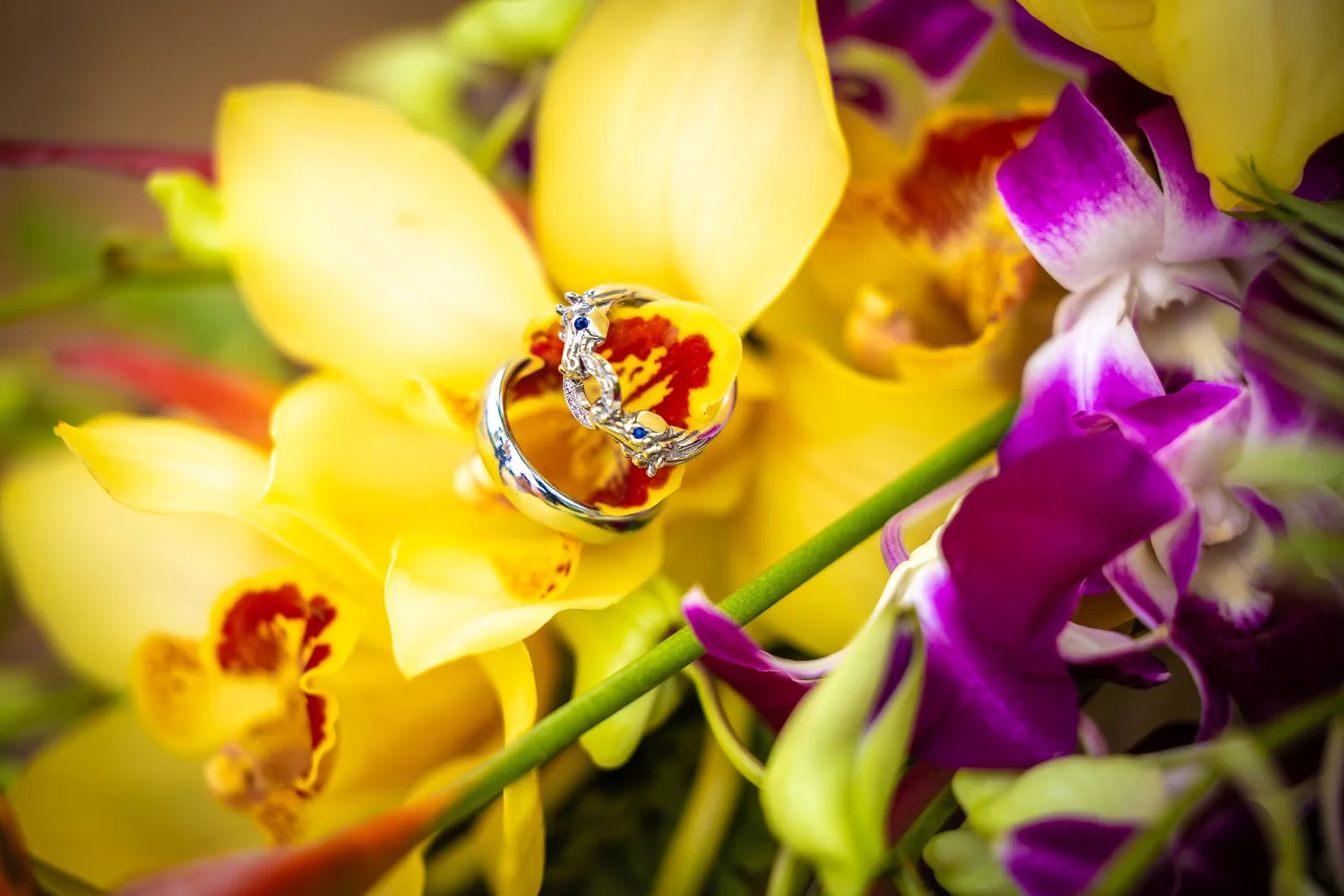
A single king protea makes a dramatic bouquet on its own, and smaller proteas mix beautifully with plumerias and orchids. We have even rested wedding rings inside a protea for a ring photo. Read the whole story on our king protea page, and see the king protea at our weddings.
Torch ginger & red ginger
See also: Tropical wedding flowers
The torch ginger sends up a tall stalk topped with a waxy, rose pink or red “torch” of bracts, sometimes higher than a person’s head. It is native to Southeast Asia, where its flower buds are also used in cooking, and it has been carried to tropical gardens around the world, Hawaii among them.[6] In Hawaiian it is called ʻawapuhi koʻokoʻo, and in the islands it is found in cultivation, in gardens and on flower farms.[7]
Its cousin the red ginger (Alpinia purpurata) is smaller, with glossy red bracts stacked like a cone. Red ginger is one of the most familiar flowers in Hawaiian arrangements and lines many island roadsides and gardens.
At weddings
A single torch ginger at the start of the aisle makes a striking welcome, and red ginger looks wonderful along the chairs, in flower circles and with pineapples on a pineapple princess pathway. See torch ginger and red ginger at our weddings and our flower pathways.
Anthurium
Main article: Anthurium
The anthurium has a glossy, heart shaped “flower” that is really a colorful leaf called a spathe, with a slender spike of tiny true flowers at its center. Its shiny red hearts have become one of the best known symbols of Hawaii.
Arrival in Hawaii
The anthurium was brought to Hawaii from London in 1889 by Samuel Mills Damon, who described his first plant as having a shell pink spathe. It grew on the Damon estate at Moanalua on Oʻahu, and from there it was slowly shared with other growers.[9]
Growers learned to raise anthuriums from seed in the late 1930s and 1940s, and a University of Hawaiʻi breeding program begun around 1950 helped turn a backyard hobby into a major industry, with new colors from deep red to pink, white, green and coral.[9][8] By 1959 there were about 266 anthurium farms in Hawaii, and Pāhoa on the Big Island was called the anthurium capital of Hawaii. Anthuriums are still among the most important cut flowers grown in the islands and are shipped to the mainland, Canada, Japan and Europe.[9]
At weddings
Red anthuriums make a bold, long lasting bouquet, and green and white anthuriums give a fresh, modern look along the aisle. They are also a favorite resting place for the wedding rings. Read the full story, colors and history on our anthurium page, and see anthuriums at our weddings.
Bird of paradise
Main article: Bird of paradise
The bird of paradise looks like a tropical bird in flight, with an orange crest and a blue “beak” rising from a pointed green sheath. It grows wild in the Eastern Cape and KwaZulu-Natal of South Africa, where it is called the crane flower and is pollinated by sunbirds that perch on the sheath to drink its nectar.[10]
It reached Britain in 1773 and was grown at the Royal Botanic Gardens at Kew. Joseph Banks named it in 1788 for Queen Charlotte, of the house of Mecklenburg-Strelitz.[10] From Europe it traveled to warm places around the world; it is the official flower of Los Angeles, and in Hawaii it is grown in gardens and recorded in cultivation on Oʻahu and Kauaʻi.[10][11]
Read more and see over 30 photos on our bird of paradise wedding flowers page.
Heliconia
See also: Tropical wedding flowers
Heliconias are big tropical plants with banana like leaves and flowers made of bright, boat shaped bracts in red, orange, yellow and green, stacked upright or hanging in long chains. Their shape gives them the nickname lobster claw. They come from the tropical Americas and the Caribbean; one species, Heliconia caribaea, has been present in Hawaii since 1958.[12] Today heliconias are grown in gardens across the islands and are a favorite in large tropical arrangements.
At weddings
Tall heliconias make a dramatic flower circle or a frame for the arch, and the rainbow varieties bring every color of the tropics at once. See heliconia at our weddings and our flower circles.
Hibiscus
Main article: Hibiscus
The hibiscus is the flower most people picture when they think of Hawaii. Its big, silky blooms open fresh every morning in a rainbow of colors, each with a long stamen rising from the center. Hawaii has both its own native hibiscus species and thousands of garden hibiscus that were brought to the islands and bred here.
Hawaii’s state flower
The hibiscus was first named Hawaii’s flower in 1923, but no particular kind was chosen, so many people assumed it meant the common red garden hibiscus.[14] In 1988 the Legislature settled the question with Act 177, approved on June 6, 1988, naming the native yellow hibiscus, maʻo hau hele (Hibiscus brackenridgei), as the official state flower.[13] It is a shrub or small tree with bright yellow flowers, and all three of its subspecies are now federally listed as endangered.[15]
Native Hawaiian hibiscus
Besides the yellow maʻo hau hele, Hawaii has other native hibiscus, including the red kokiʻo ʻula and the white kokiʻo keʻokeʻo, one of the few hibiscus with a sweet fragrance. Many of them are rare in the wild today and are protected and grown by botanical gardens.[16]
Colors of the garden hibiscus
Most hibiscus you see in Hawaiian gardens, hotel grounds and leis are the tropical garden hibiscus (Hibiscus rosa-sinensis) and its many hybrids. Growers in Hawaii have bred thousands of varieties, and the colors seem endless: soft baby pink and blush, hot pink and deep magenta, classic red, sunny yellow, orange and coral, pure white, and blends with a dark “eye” at the center or a different color on the edges of the petals. Some open in one color and soften to another by evening. Each flower lasts only a day, but the plant blooms all year long.
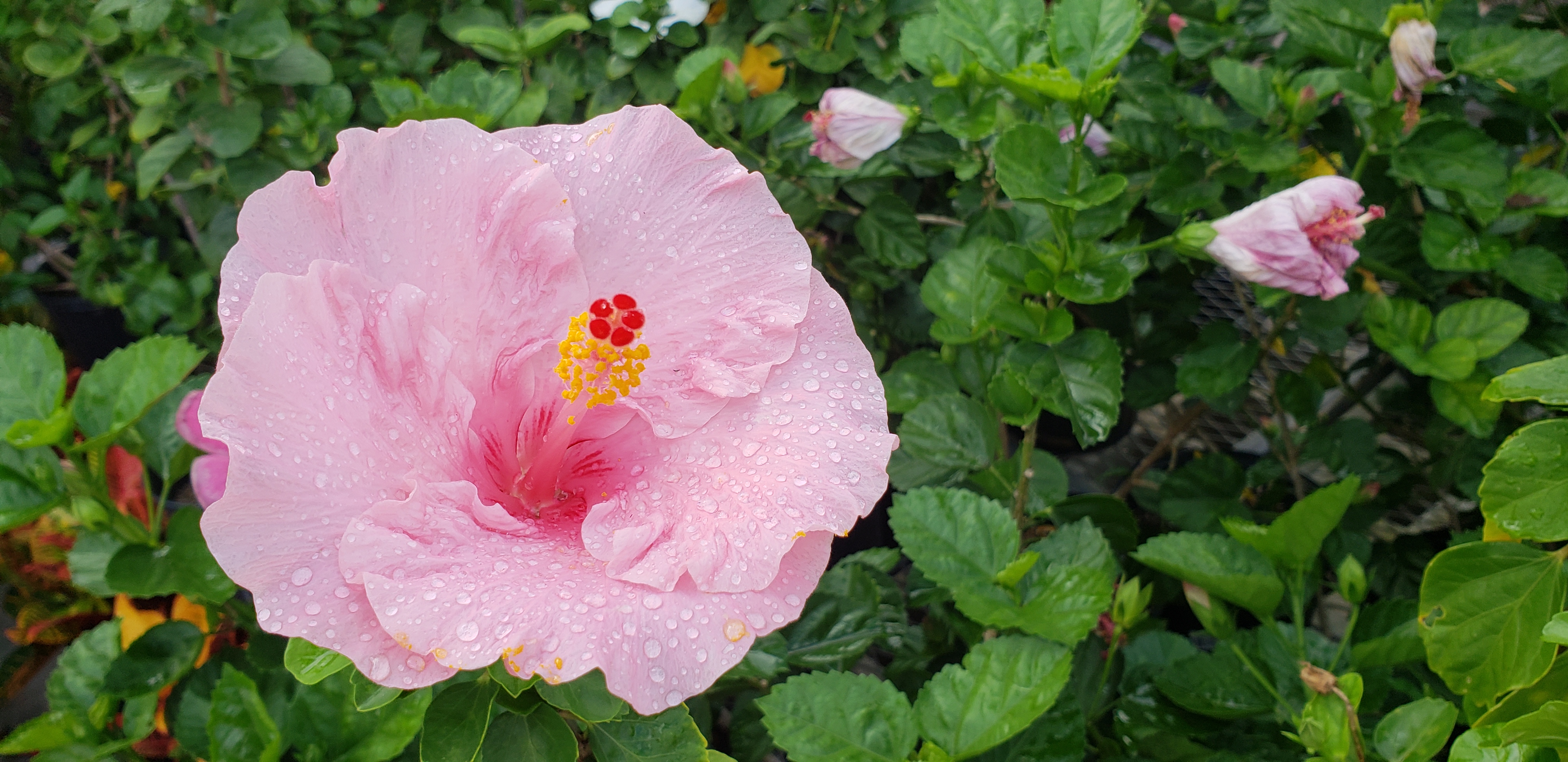
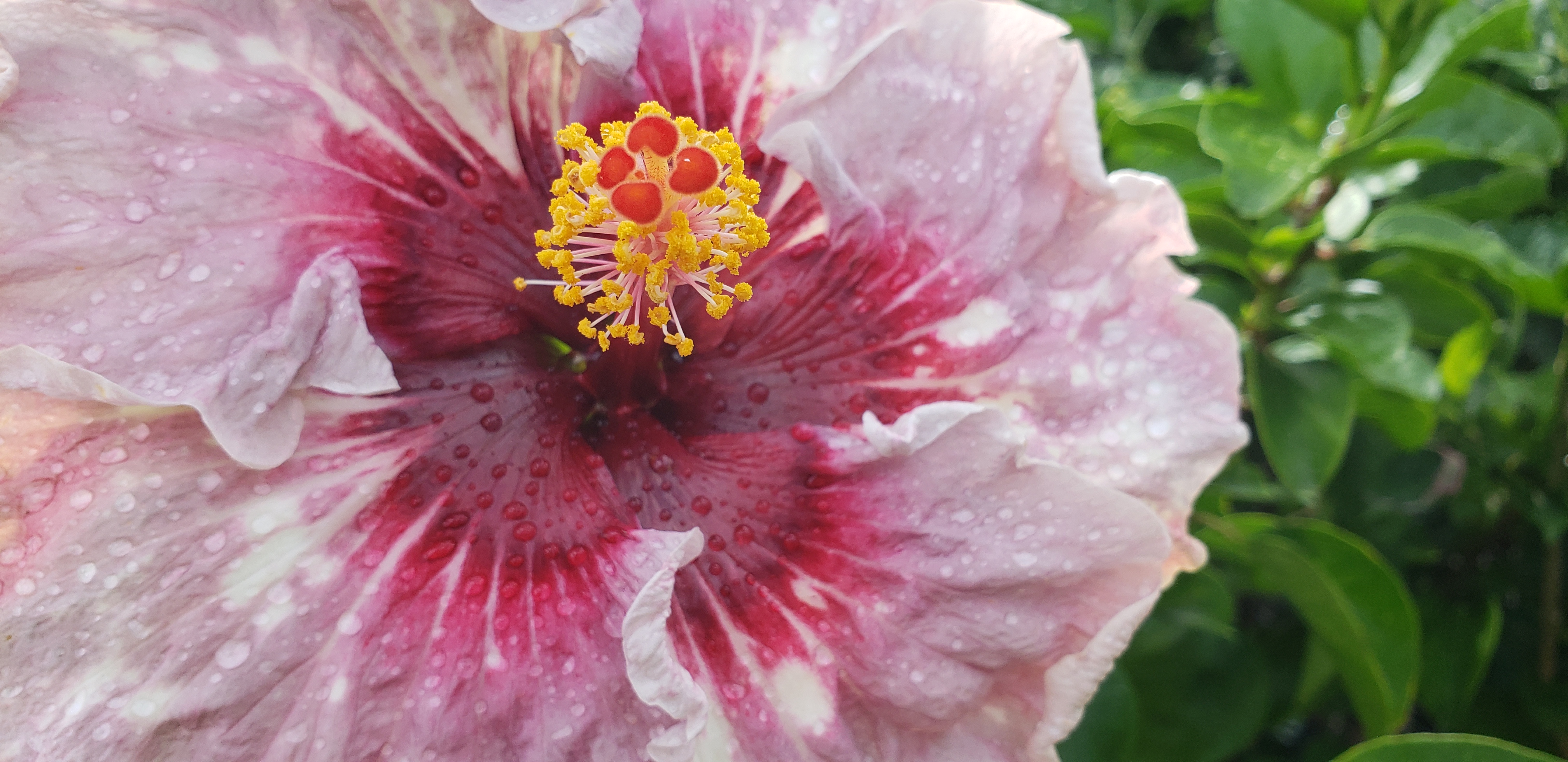
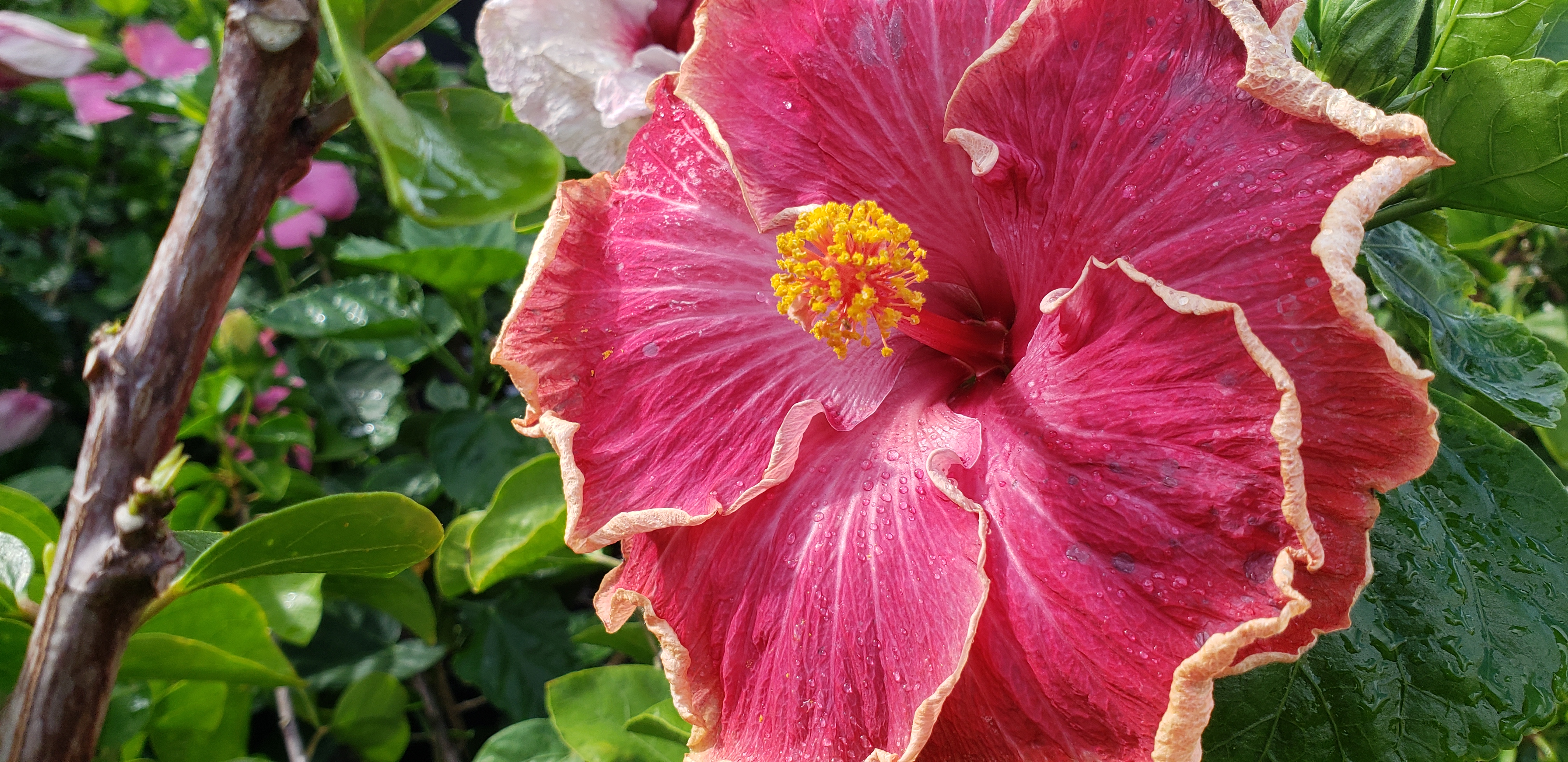


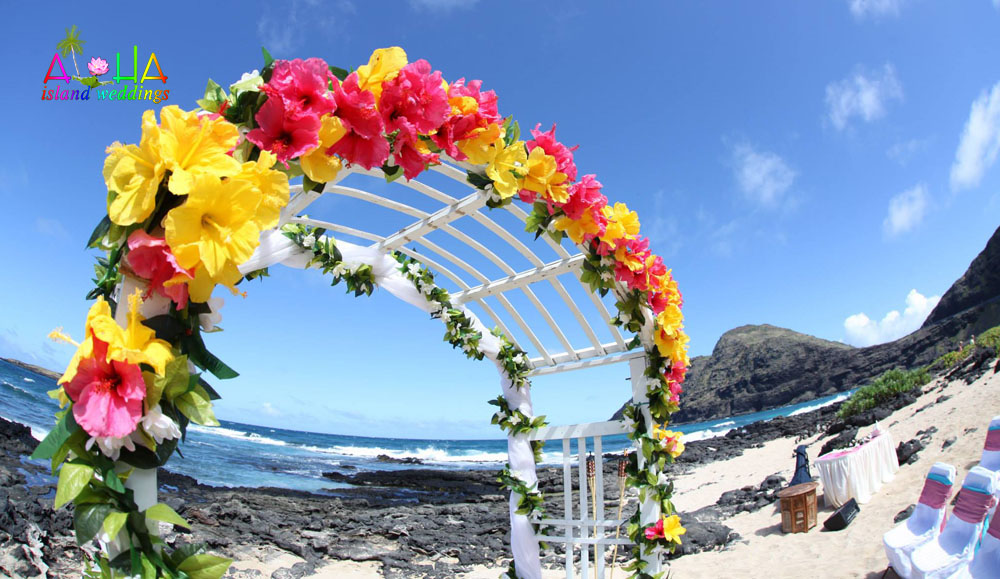
A hibiscus behind the ear
In Hawaii a flower worn behind the ear has a sweet meaning: over the right ear it says you are single, and over the left ear, closer to the heart, it says you are taken. On your wedding day, the left ear it is.
See over 60 photos on our hibiscus wedding flowers page.
Plumeria
Main article: Plumeria
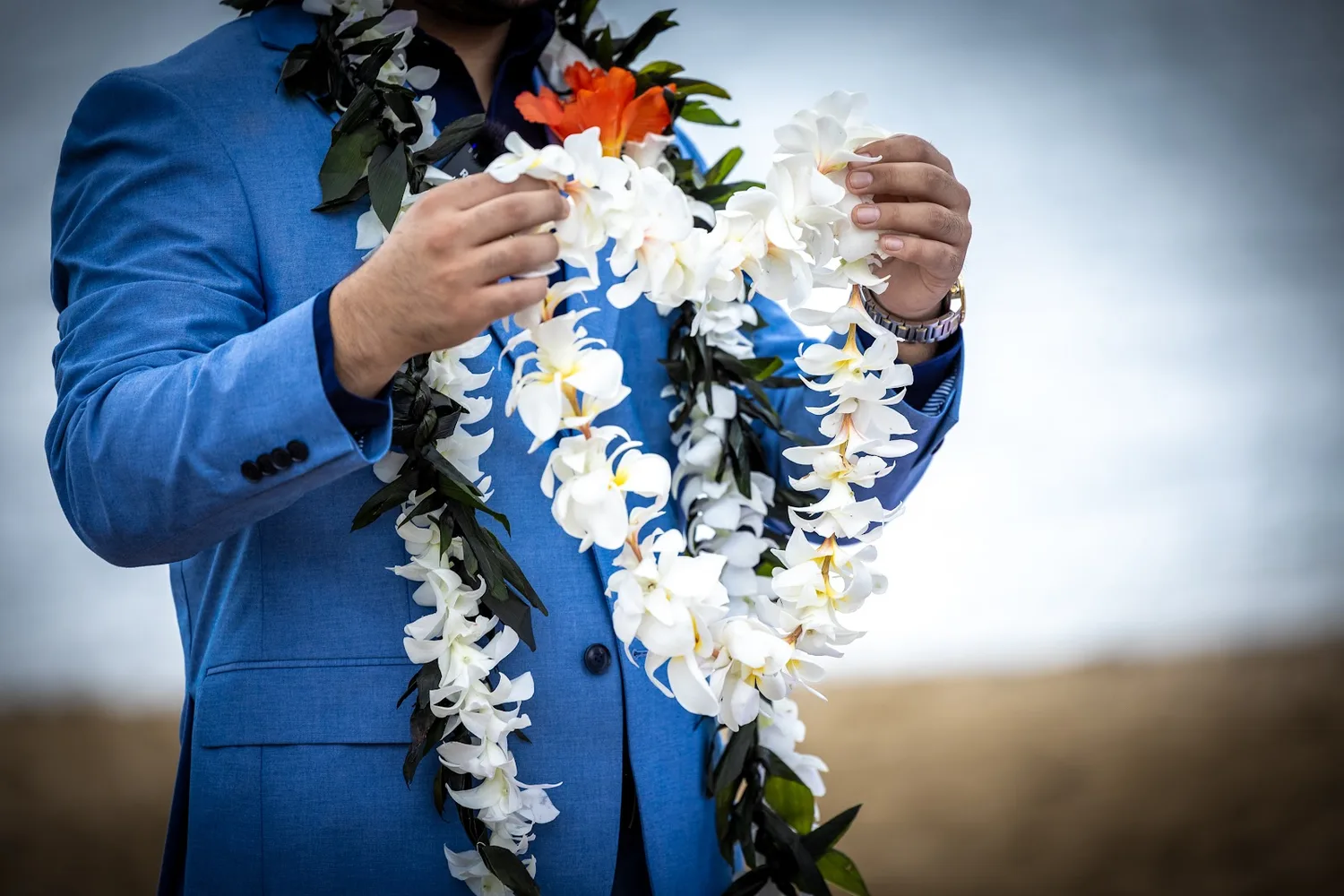
The plumeria, the flower of the classic Hawaiian lei, is not native to Hawaii either. It comes from Mexico, Central America and the Caribbean. The German physician and botanist William Hillebrand, who lived in Honolulu and was chief physician of The Queen’s Hospital from 1860 to 1871,[17] is credited with bringing the first plumeria to Hawaii, a yellow flowered tree, around 1860.[18] Today plumerias grow everywhere in the islands, in white, yellow, pink, red and rainbow blends, and their sweet fragrance is the scent of Hawaii for many visitors. See our plumeria wedding flowers.
Exotic flowers at Hawaii weddings
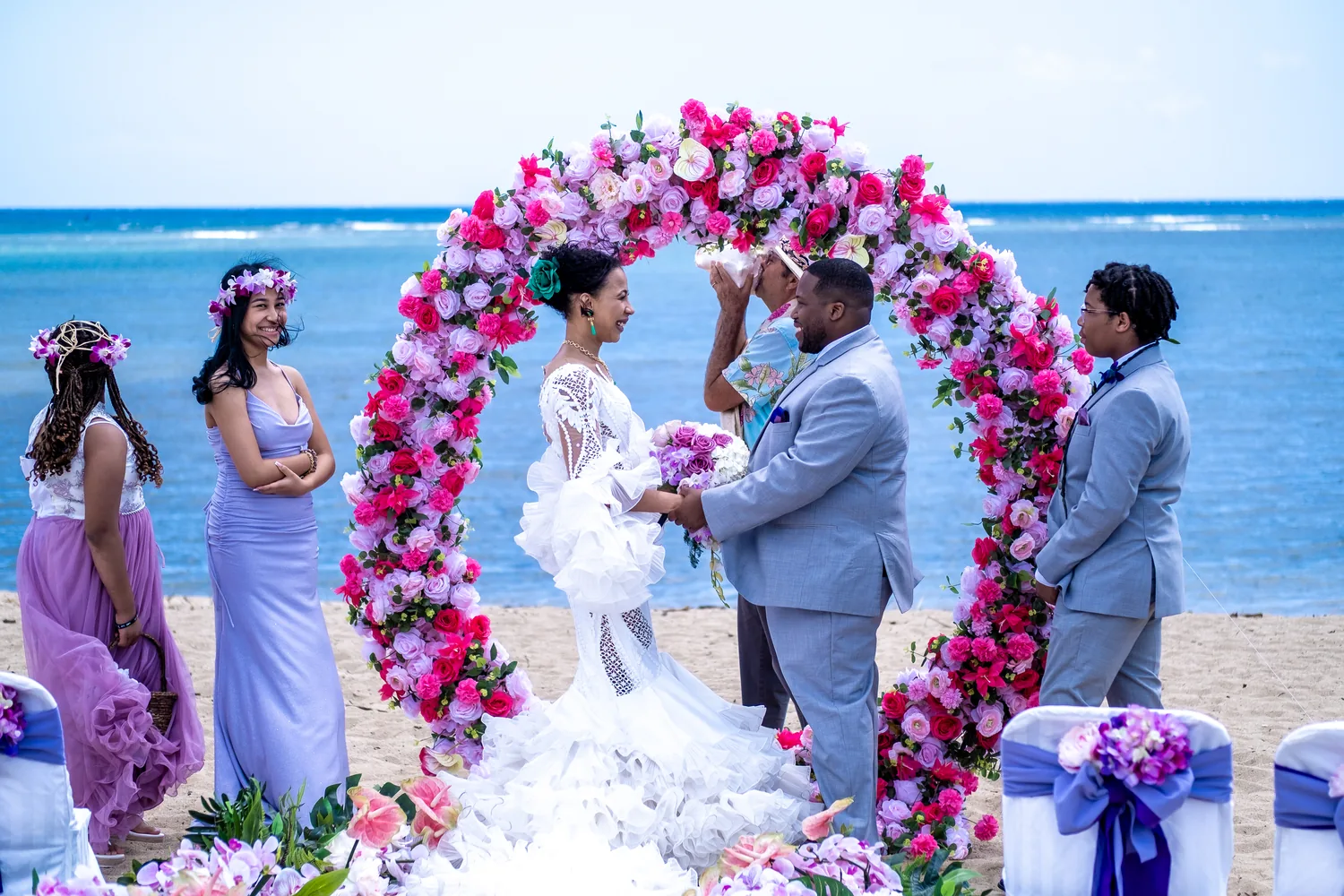
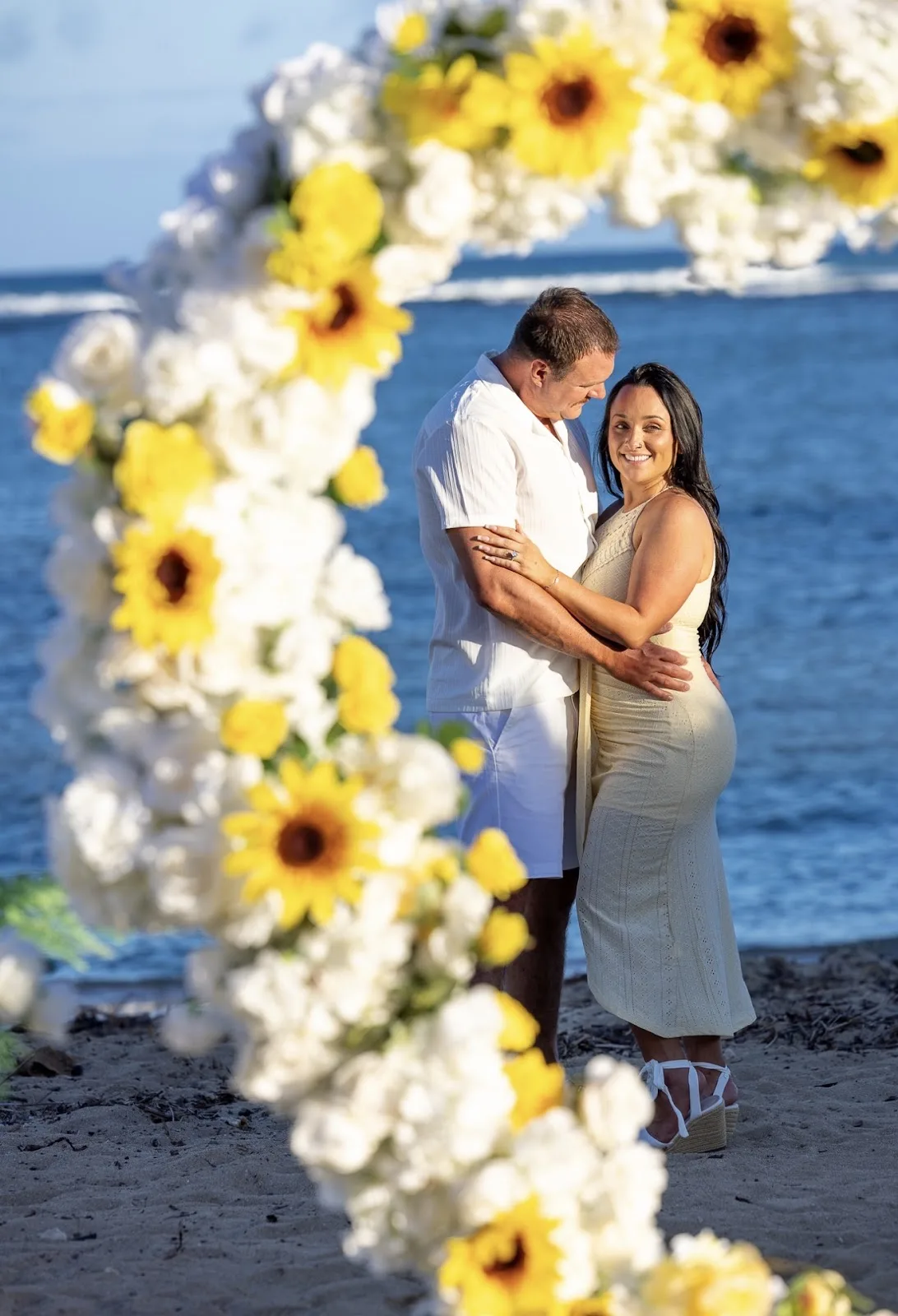
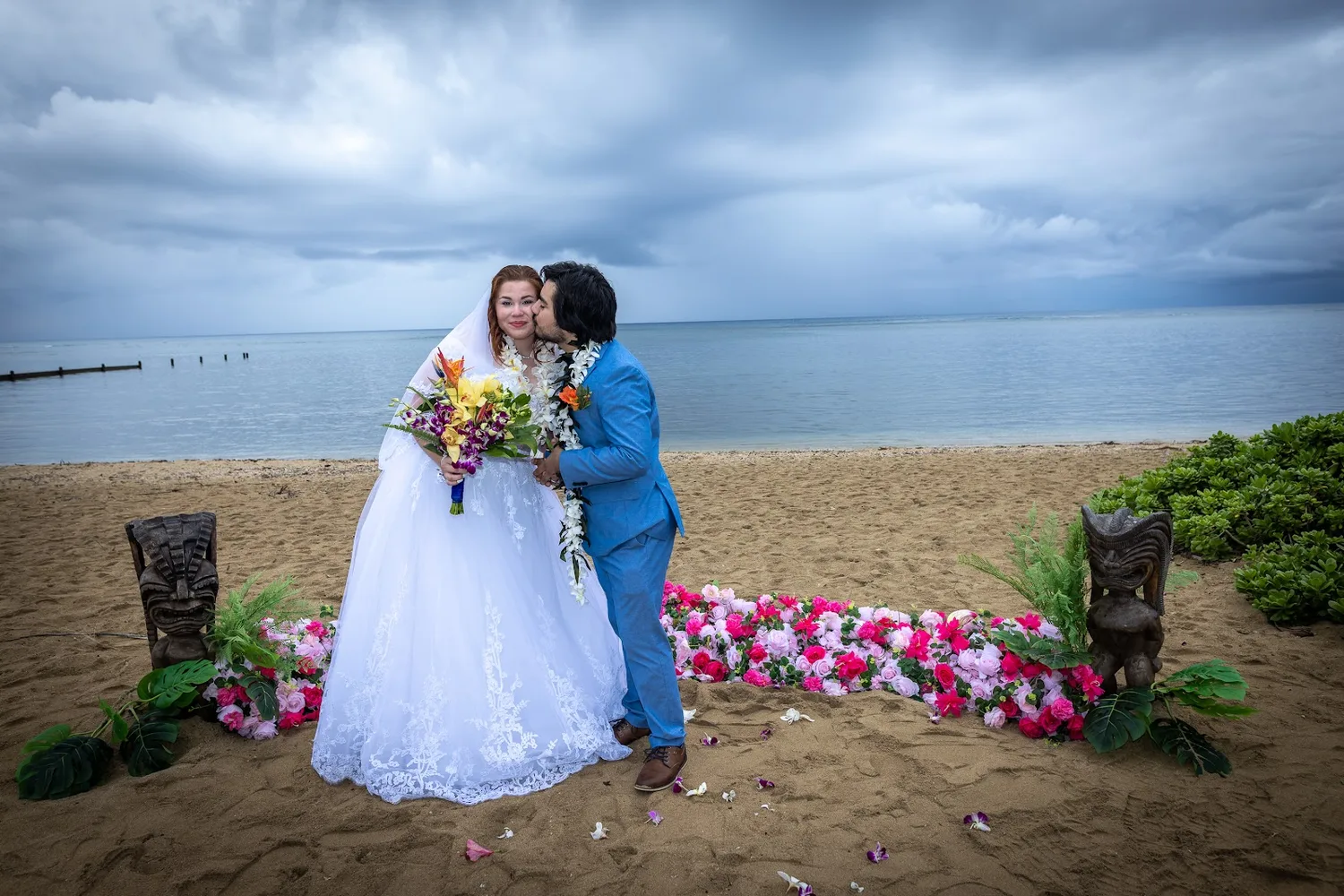
Tropical flowers are made for beach weddings. Proteas, anthuriums, gingers, heliconias and birds of paradise have thick, waxy petals and strong stems that hold up to the sun and the trade winds, so they look as fresh at the end of the ceremony as they did at the start. Plumerias and hibiscus are more delicate and are best picked the same day, which is easy in the islands, where they bloom all year.
At Aloha Island Weddings we have used these flowers for more than twenty years: in bouquets and haku leis, along the aisle, on the arch, in flower circles and even on the wedding cake. See our tropical wedding flowers, bouquets and wedding packages.
References
- Protea cynaroides. Wikipedia.
- Protea: a new crop for Hawaii (New Crops proceedings, 1999). Purdue University.
- Proteas in the garden (1999). Honolulu Star-Bulletin.
- Key player in Hawaii’s protea industry dies (2013). The Maui News.
- Maui: a swing through the island’s wide-open Upcountry (1984). Christian Science Monitor.
- Etlingera elatior. Wikipedia.
- Etlingera elatior. Plants of Hawaii.
- Anthurium Culture in Hawaiʻi. University of Hawaiʻi, CTAHR.
- Anthuriums. American Phytopathological Society.
- Strelitzia reginae. Wikipedia.
- Strelitzia reginae. Plants of Hawaii.
- Heliconia caribaea. Plant Pono.
- Hawaii’s state flower history (2009). The Honolulu Advertiser.
- Maʻo hau hele (Hawaiian hibiscus). Maui Ocean Center.
- Hibiscus brackenridgei. University of Hawaiʻi Native Plants.
- Grow Aloha: Native Hawaiian hibiscuses. National Tropical Botanical Garden.
- William Hillebrand. Wikipedia.
- Ever Green (1997). Honolulu Star-Bulletin.