This article is about the anthurium and its history in Hawaii. For other tropical flowers of the islands, see Exotic Hawaiian Flowers.
A heart of red lacquer on a green stem, shining as if the rain had just kissed it. Hawaii borrowed the anthurium from the far rainforests of South America, and then made it her own.
Anthurium (pronounced an-THOOR-ee-um) is a genus of about 1,000 species of flowering plants, the largest genus in the arum family, Araceae.[1] It is native to the tropical Americas, from northern Mexico to northern Argentina and parts of the Caribbean.[1] Its best known member, Anthurium andraeanum, has glossy, heart shaped spathes in red, pink, white, green and many other colors, and is grown around the world as a cut flower and houseplant.
The anthurium is not native to Hawaii, but it has become one of the islands’ best known symbols. It was brought to Oʻahu from London in 1889, grew into a major flower industry on the Big Island in the 20th century, and remains one of the most important cut flowers grown in the state.[2]
Description and biology
Anthuriums are herbaceous plants. In the wild many grow as epiphytes, perched on the trunks and branches of rainforest trees, while others root in the forest floor. Their leaves are often clustered and vary widely in shape, from long and narrow to broad and heart shaped, and some species are grown for their velvety, silver veined foliage alone.
What looks like a single flower is an inflorescence made of two parts. The spadix is the slender spike at the center; it is covered in tiny flowers arranged in tight spirals, each of which is perfect, with both male and female parts. Below it sits the spathe, a modified leaf, or bract, which in the cut flower anthurium is the glossy colored “heart.” After pollination the flowers on the spadix ripen into small, juicy berries, each usually holding two seeds.
Of all the species, only A. andraeanum and A. scherzerianum naturally have bright red spathes, which is why nearly all of the colorful anthuriums in florists’ shops, including those grown in Hawaii, are hybrids of these two.
History in Hawaii
Arrival (1889)
The anthurium was introduced to Hawaii in 1889 by Samuel Mills Damon, a son of missionaries and a leading businessman of the Hawaiian Kingdom, who brought A. andraeanum from London. He described his first plant as having a shell pink spathe. It was grown on the Damon estate at Moanalua on Oʻahu, and from there cuttings were slowly passed on to other growers.[2]
A Hawaiian industry
For decades anthuriums in Hawaii were spread only by cuttings. In the late 1930s and 1940s growers learned to raise them from seed, and new varieties began to appear; several from that period, including ‘Ozaki’, ‘Nitta’, ‘Kozohara’, ‘Kaumana’ and ‘Madame Butterfly’, are still grown, and ‘Ozaki’ became the most popular commercial anthurium in the islands.[4]
In 1950 Dr. Haruyuki Kamemoto began an anthurium breeding program at the University of Hawaiʻi.[2][6] By 1959 there were about 266 anthurium farms in the state, and Pāhoa, in the Puna district of the Big Island, was known as the anthurium capital of Hawaii. Hawaiian anthuriums were exported to the U.S. mainland, Canada, Japan and Europe.[2] The university later released many named Hawaiian cultivars,[7] and Kamemoto and Adelheid Kuehnle described the program in Breeding Anthuriums in Hawaii (1997).[5]
The blight years
Anthurium blight, a bacterial disease, was first noticed on Kauaʻi in the early 1970s. In 1981 it began killing plants in large numbers on farms around Hilo.[2] From 1985 to 1989 the disease reached epidemic levels and about 200 small farms went out of business,[8] and the state’s harvest fell from a record of about 30 million stems to 15.6 million by 1990.[3] Clean planting material, new farm practices and blight tolerant cultivars developed with the University of Hawaiʻi brought the disease under control,[9] and in 2004 anthuriums were still the state’s top cut flower, worth $4.7 million of $13.1 million in cut flower sales.[3]
Cultivation in Hawaii
Anthuriums want warmth, shade, humidity and steady moisture, which makes the rainy windward side of Hawaiʻi Island, around Hilo and Puna, the heart of the state’s industry. Here they grow on the green, rain fed slopes of the island’s mountains, and instead of ordinary soil many growers plant them in beds of light, puffy volcanic cinder, the porous lava rock of the Big Island. The cinder holds air and a little water while letting the frequent rain drain away, giving the roots exactly what they love, much as the anthurium’s wild ancestors cling to airy tree bark in the rainforest. The fields are covered with shade cloth, since the plants dislike strong direct sun and soggy roots; some cultivars, such as ‘Ozaki’, need more shade than others.[4] From these Big Island farms the flowers are cut, packed in boxes and shipped around the world, so a heart grown on the slopes above Hilo may end up on a table in New York, Tokyo or Europe a few days later. In home gardens across the islands anthuriums grow happily in shady corners and under trees.
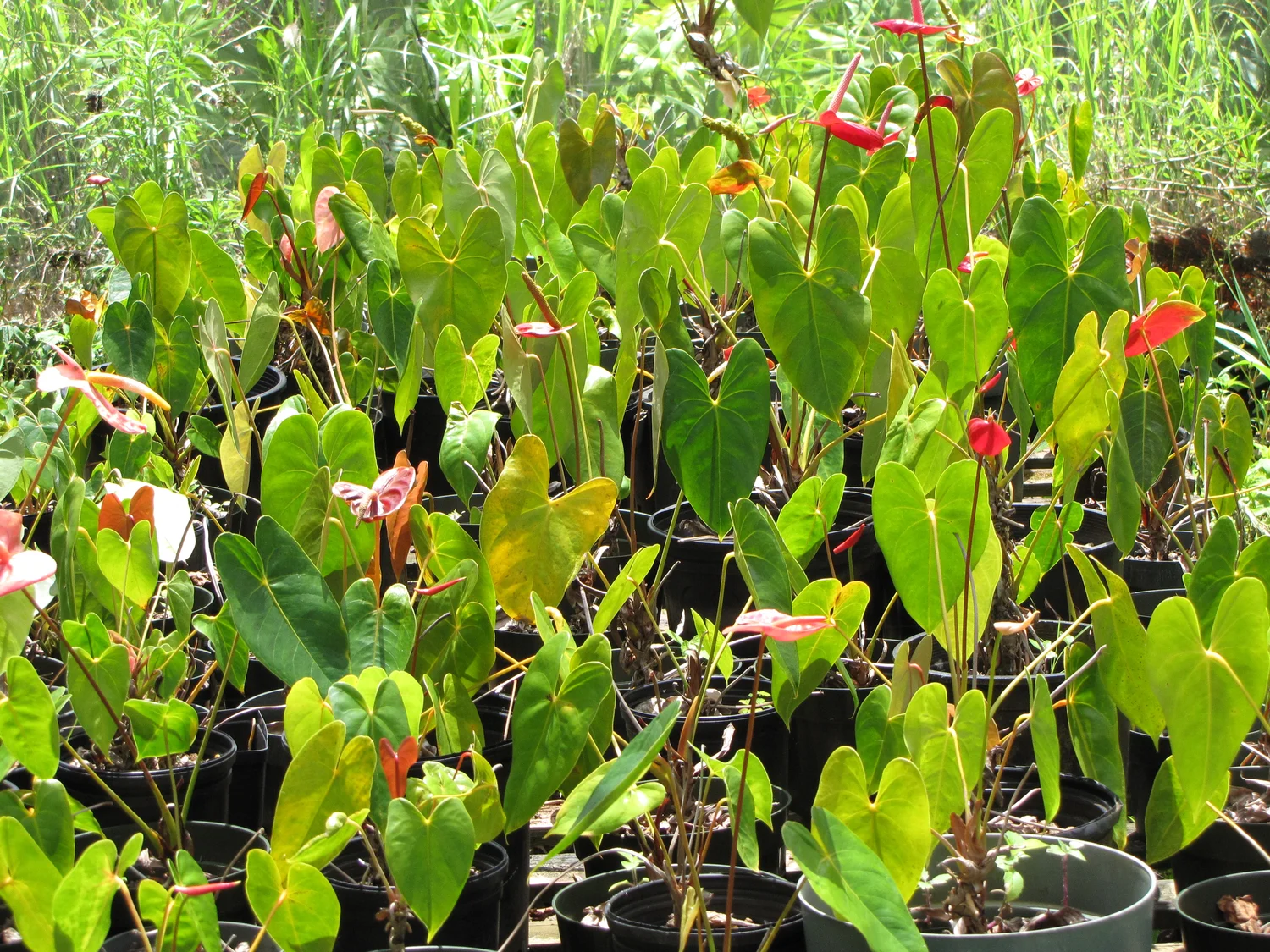
Photo: Forest and Kim Starr, CC BY 3.0 us, via Wikimedia Commons
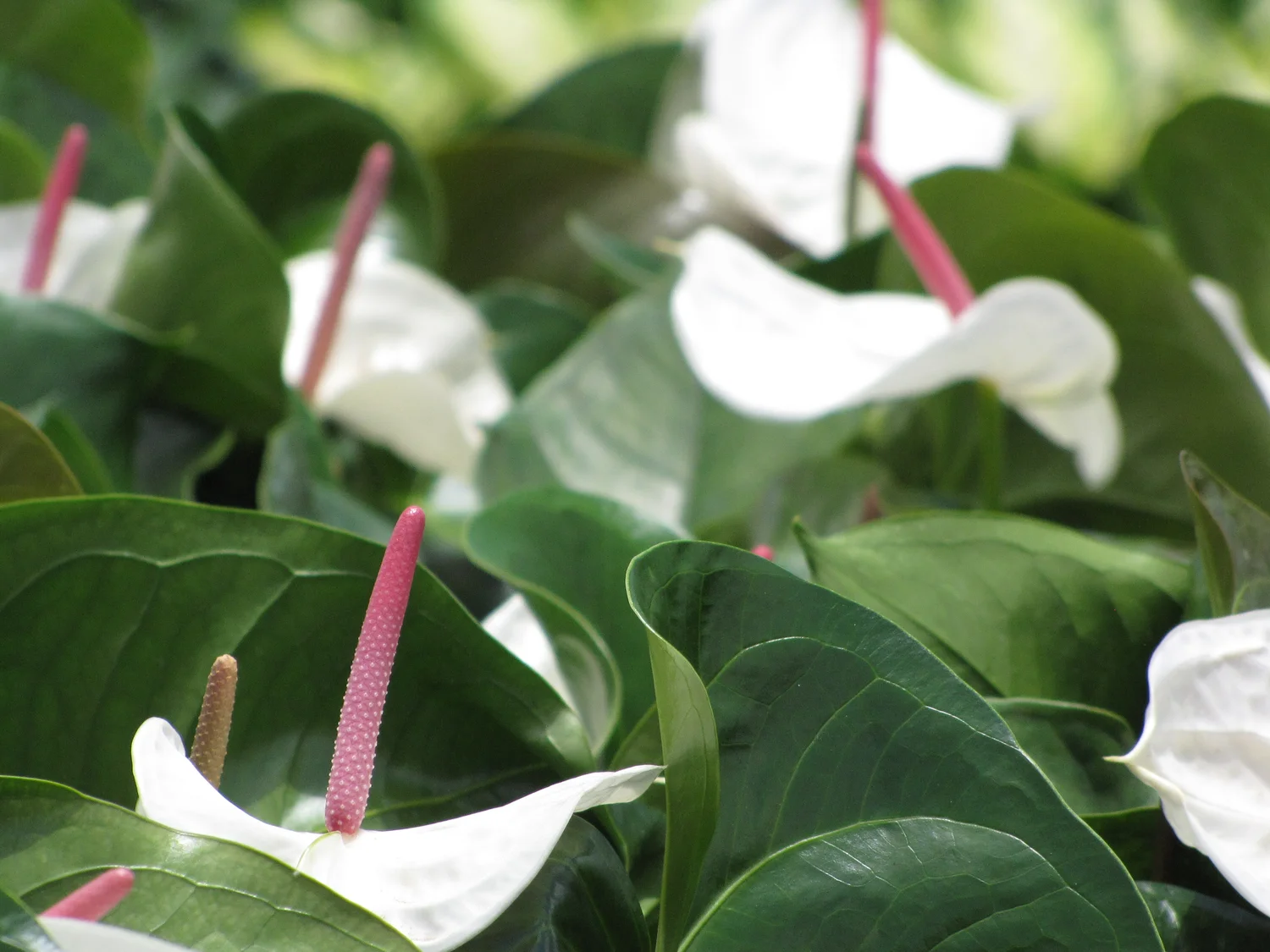
Photo: Forest and Kim Starr, CC BY 3.0 us, via Wikimedia Commons
Away from the tropics, anthuriums are popular houseplants. Indoors they do best in moist soil rich in organic matter, at about 16–22 °C (61–72 °F), in bright but indirect light, with an occasional weak feeding.[1]
Propagation
Anthuriums can be grown from seed or from cuttings, and for more than half a century of Hawaiian history cuttings from the Damon plants were the only source. Today most commercial anthuriums are propagated by tissue culture, which produces large numbers of identical, disease free young plants, an important tool against blight.[1]
Colors, shapes and styles
Few flowers come in so many looks as the anthurium. Breeders in Hawaii and around the world have played with every part of it: the color of the heart, the color of the spike, the shape and stance of the spathe and the size of the whole flower.
Colors of the heart
- Red, the classic Hawaiian anthurium, from bright cherry to deep lipstick and nearly black red, like the old favorites ‘Ozaki’ and ‘Kaumana’.
- Pink, from soft shell and blush, the color of Damon’s very first plant, to hot pink and magenta.
- Coral and orange, warm sunset shades that glow at a beach wedding.
- White, clean and elegant, a favorite for white and green bridal designs.
- Green, fresh lime and leaf green hearts.
- Chocolate, purple and lavender, rarer, moody shades that look almost unreal.
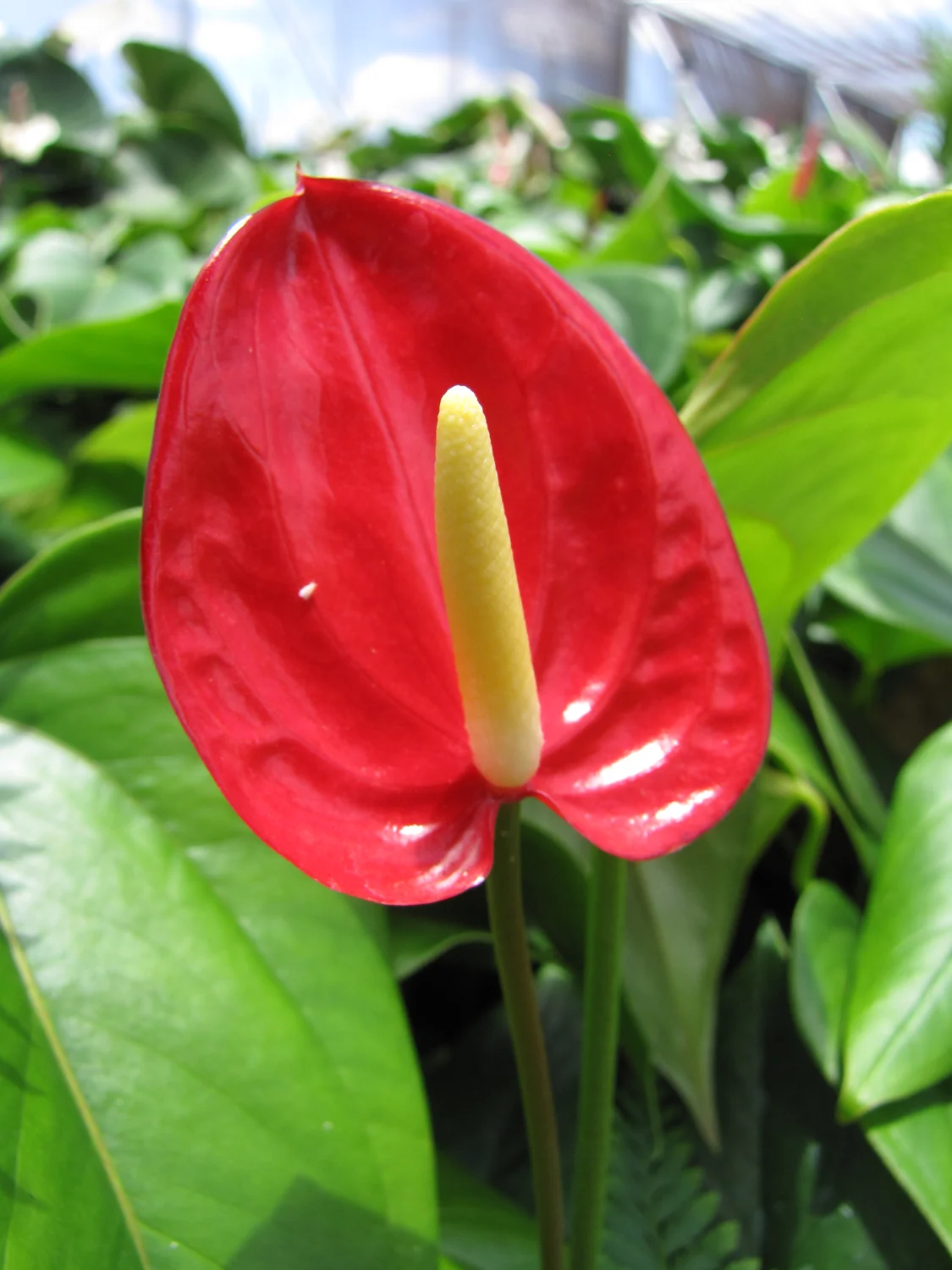
Photo: Forest and Kim Starr, CC BY 3.0 us, via Wikimedia Commons
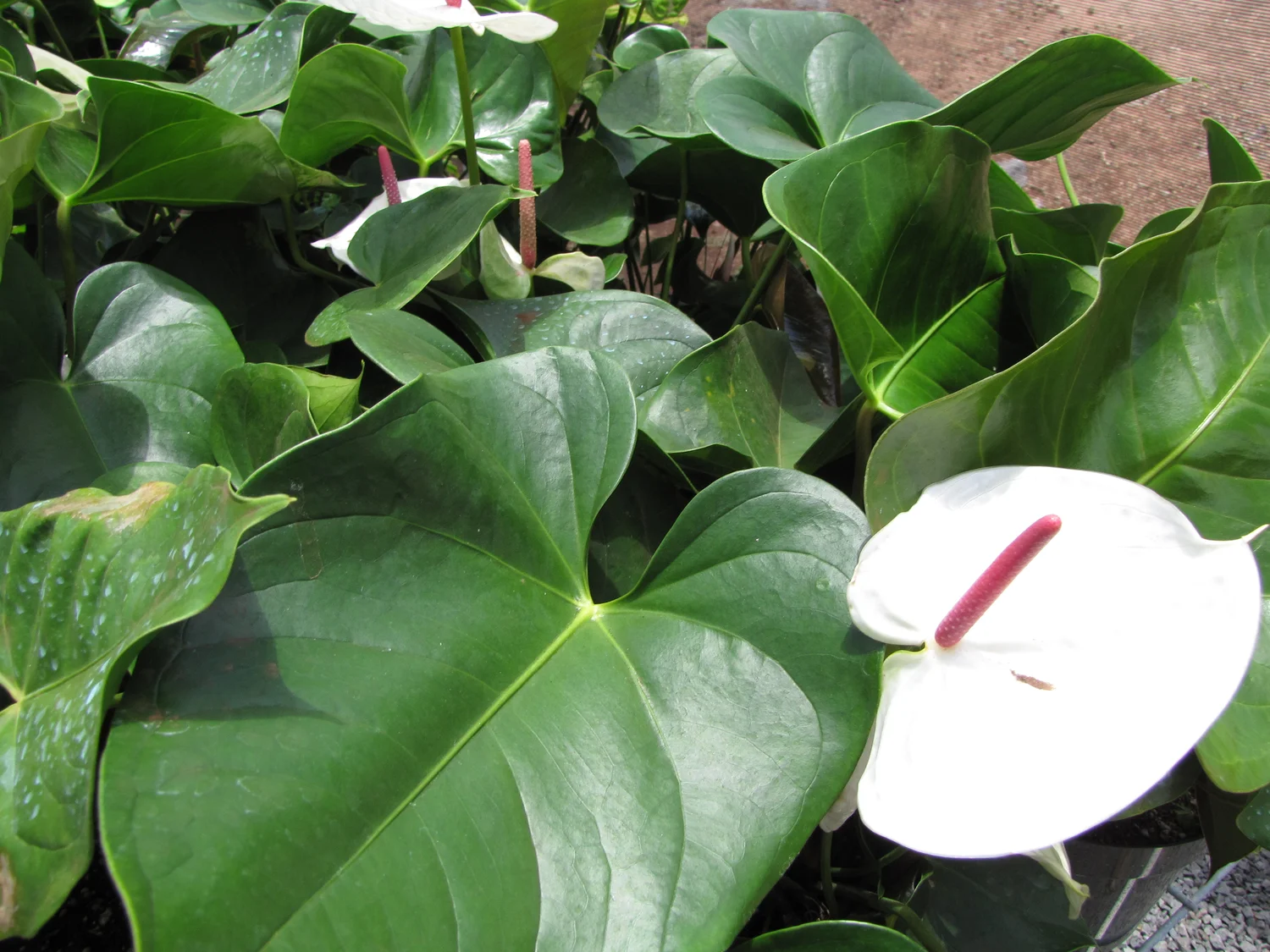
Photo: Forest and Kim Starr, CC BY 3.0 us, via Wikimedia Commons
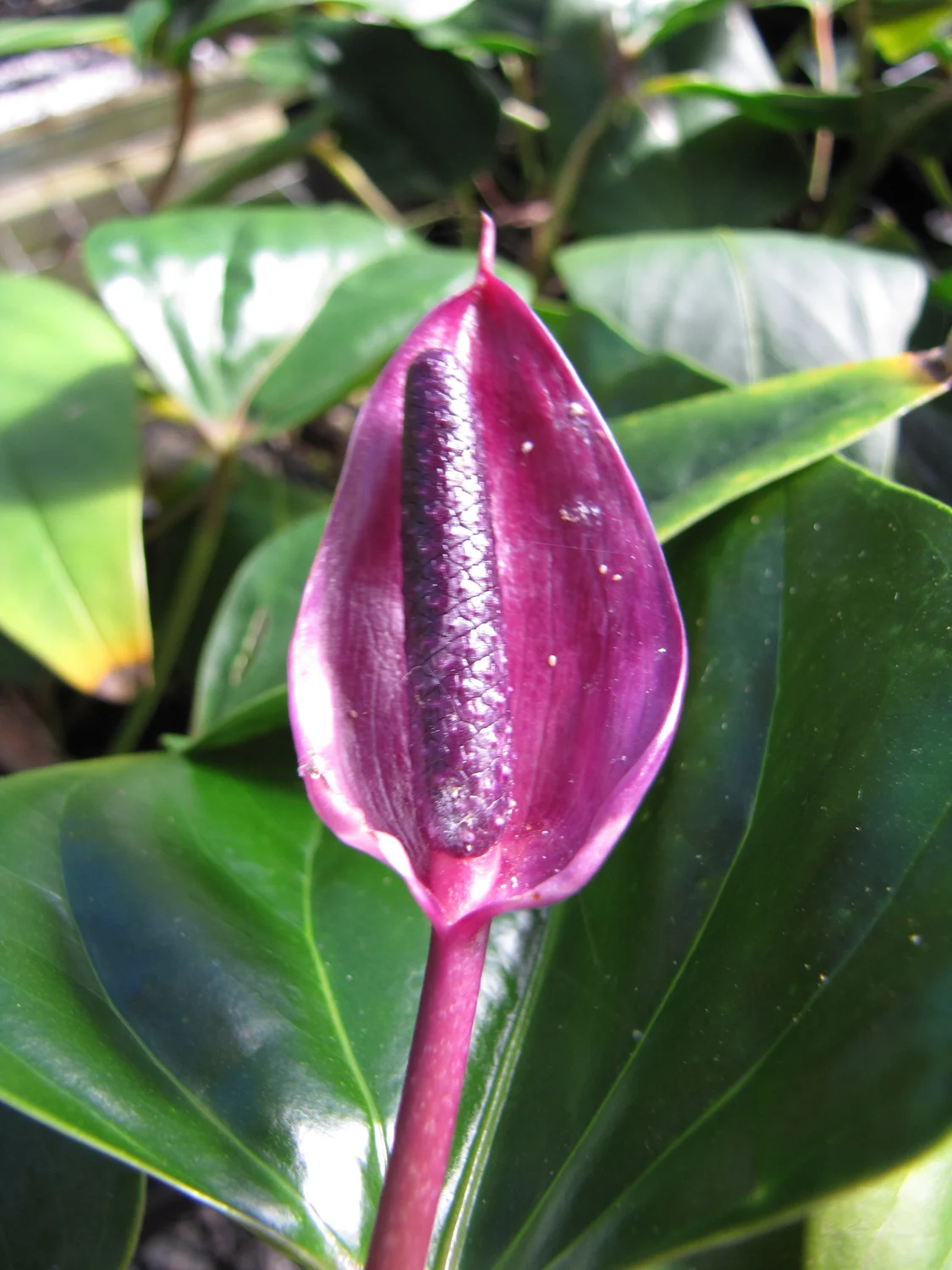
Photo: Forest and Kim Starr, CC BY 3.0 us, via Wikimedia Commons
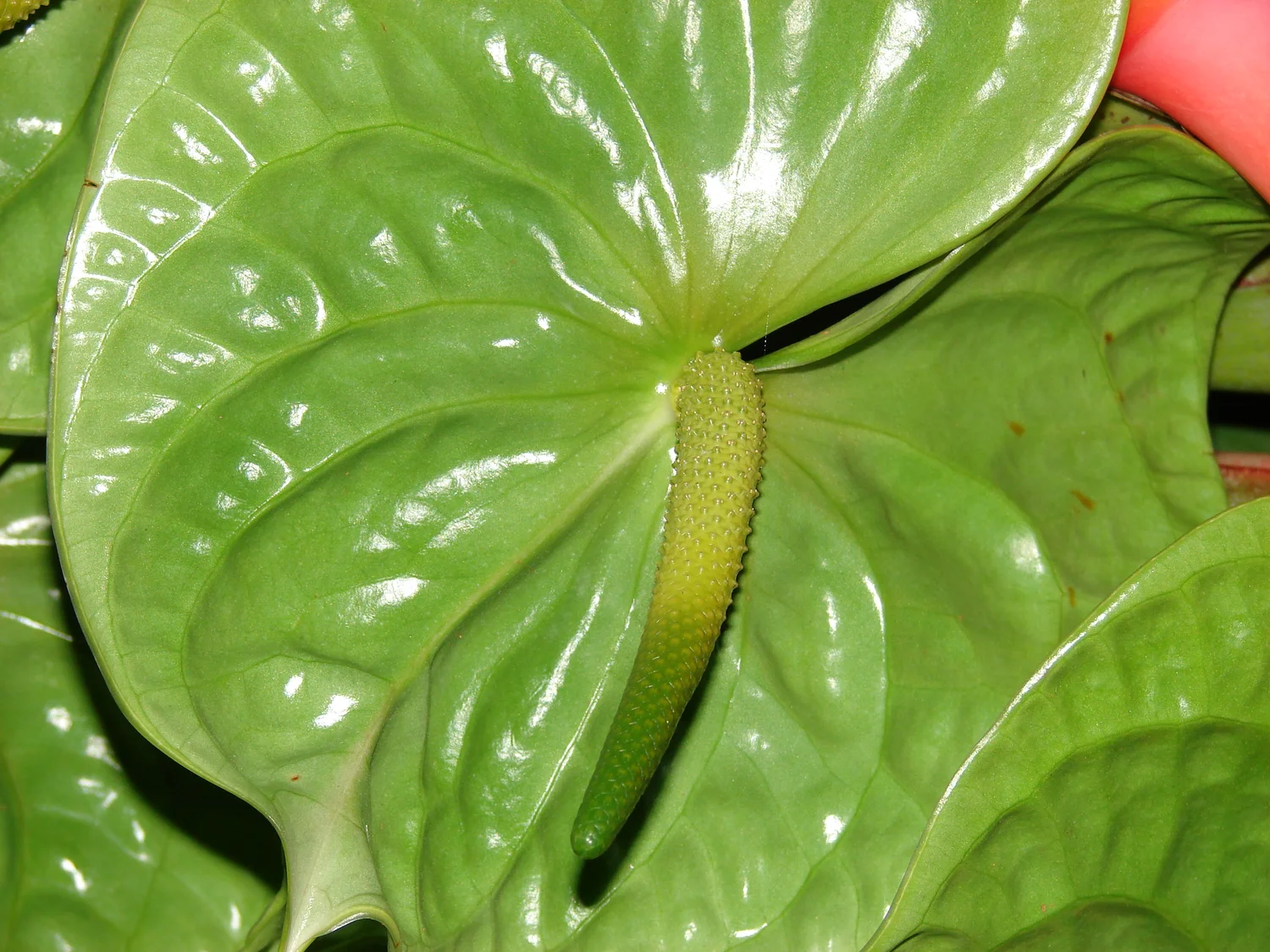
Photo: Forest and Kim Starr, CC BY 3.0 us, via Wikimedia Commons
Obake, the two-toned anthuriums
Some of the most loved anthuriums in Hawaii are the obake, whose hearts blend two colors at once: green fading into red, pink or white, often with the green running along the veins and the edges. No two obake flowers are quite alike. The green and red anthuriums in our beach photos below are obake.
Shapes and styles
- Standard: the familiar flat, open heart with a slender spike, glossy and quilted with fine ridges.
- Tulip: a cupped spathe that stands upright and wraps around the spadix like the petals of a tulip.
- Obake: often larger and more ruffled, with a broad, two-toned heart.
- Miniature: small, delicate hearts on fine stems, made for haku leis, corsages and boutonnières.
- Foliage anthuriums: grown not for the flower but for their huge, velvety leaves with silver veins.
The spike and the size
The spadix has its own palette, from yellow and cream to white, green, pink and purple, and it may stand straight, curve gently or bend back over the heart. Cut anthuriums are sold by size, from miniature hearts a few inches across to giant ones as wide as a hand span, so a florist can choose tiny ones for a lei and grand ones for a lobby arrangement.
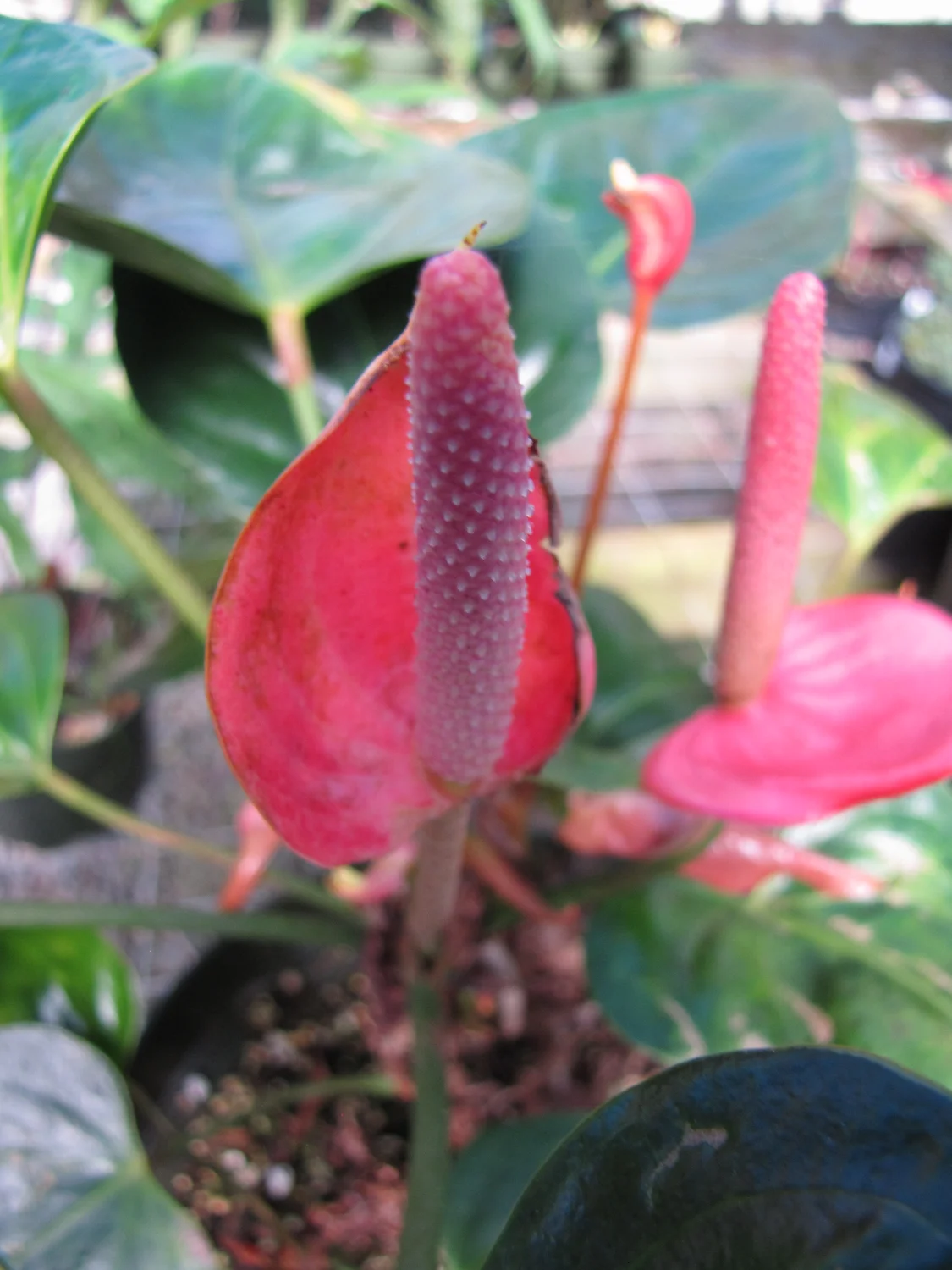
Photo: Forest and Kim Starr, CC BY 3.0 us, via Wikimedia Commons


In island life
In Hawaii the anthurium is less a flower to be admired from afar than one to be lived with. It glows in hotel lobbies and on restaurant tables, and it fills the arrangements at graduations and celebrations. Hula dancers love to tuck a bright anthurium in their hair, where its glossy heart catches the light with every sway of the hips and every turn of the hands, a small flame of color above the dance.
Where the flower sits says something too. In Hawaii, a flower worn behind the right ear tells the world you are single and available, while a flower behind the left ear, the side of the heart, says you are already taken. On a wedding day, the bride wears hers on the left.
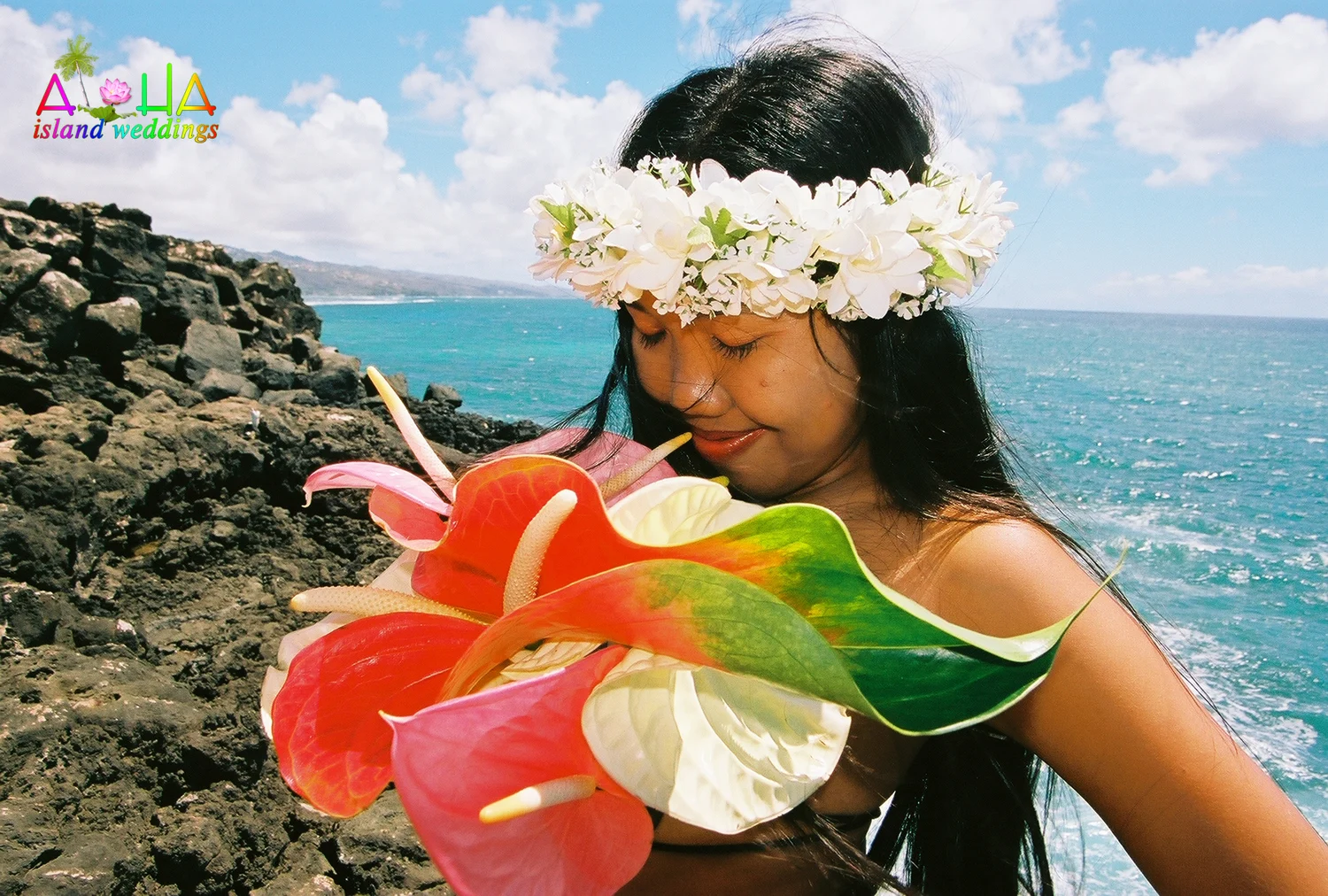
Here Dewi, Paul’s wife, dances with a bouquet of anthuriums on the lava rocks above the sea: red, blush pink, cream and two-toned obake hearts, crowned by a haku lei of white flowers.
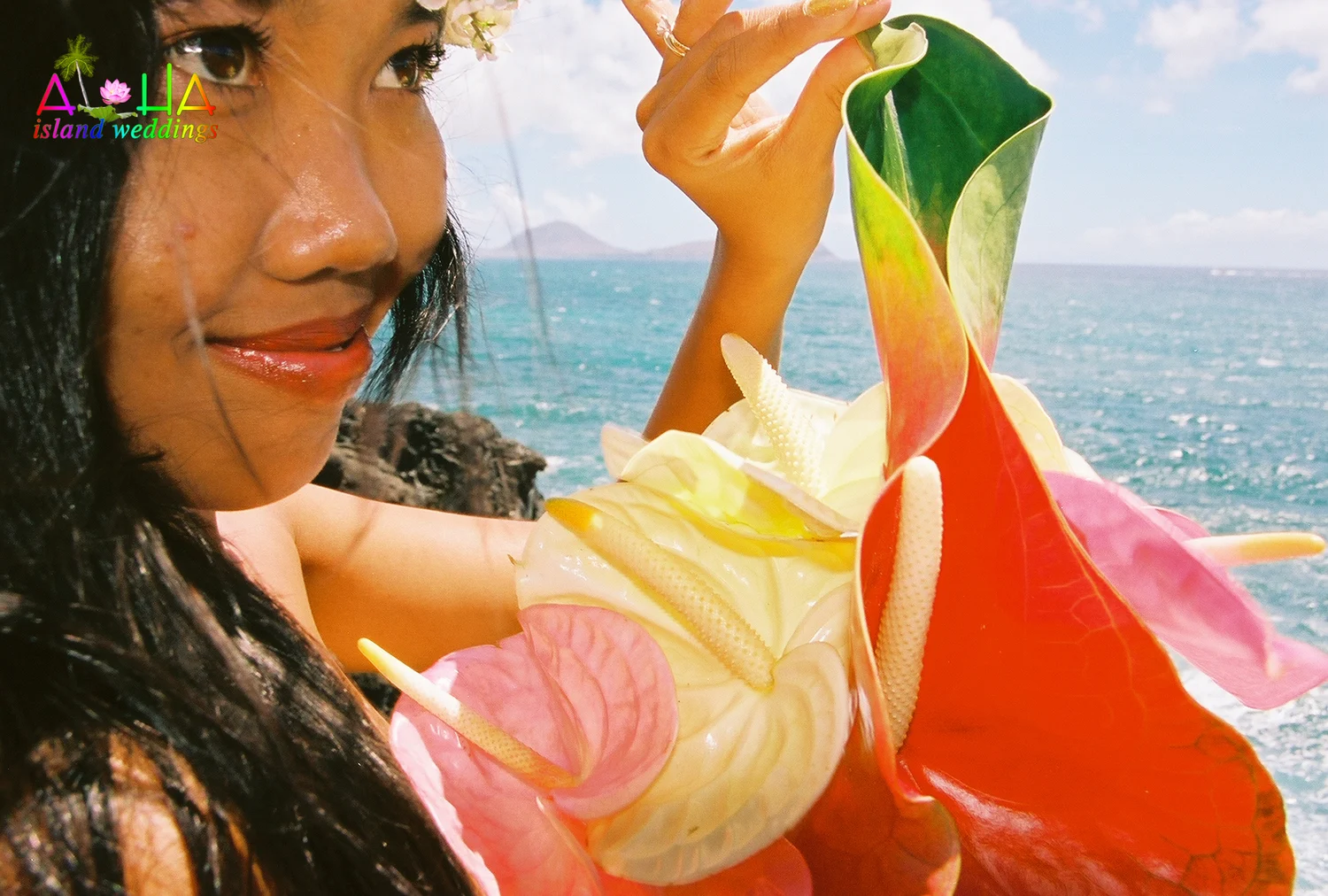
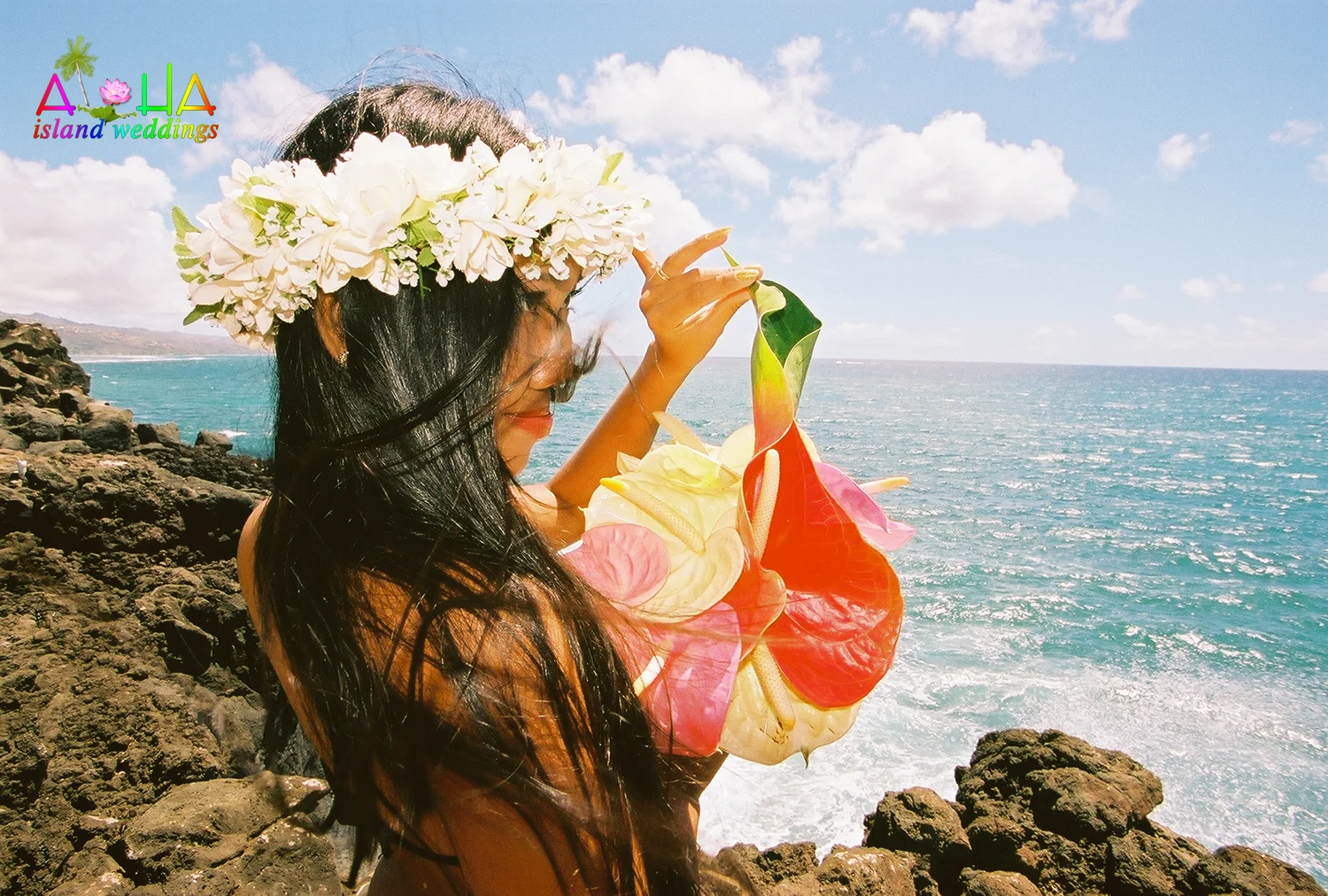
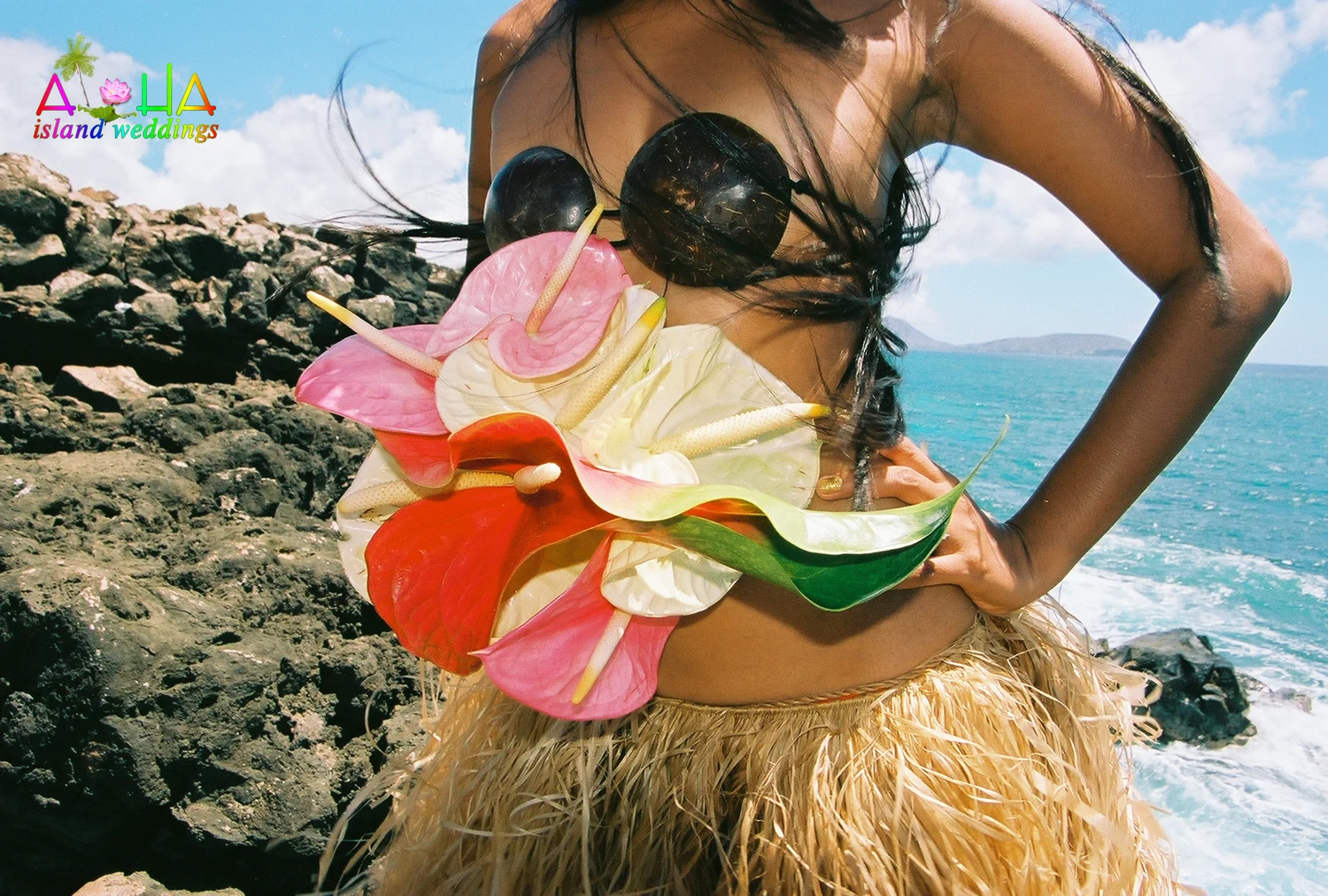
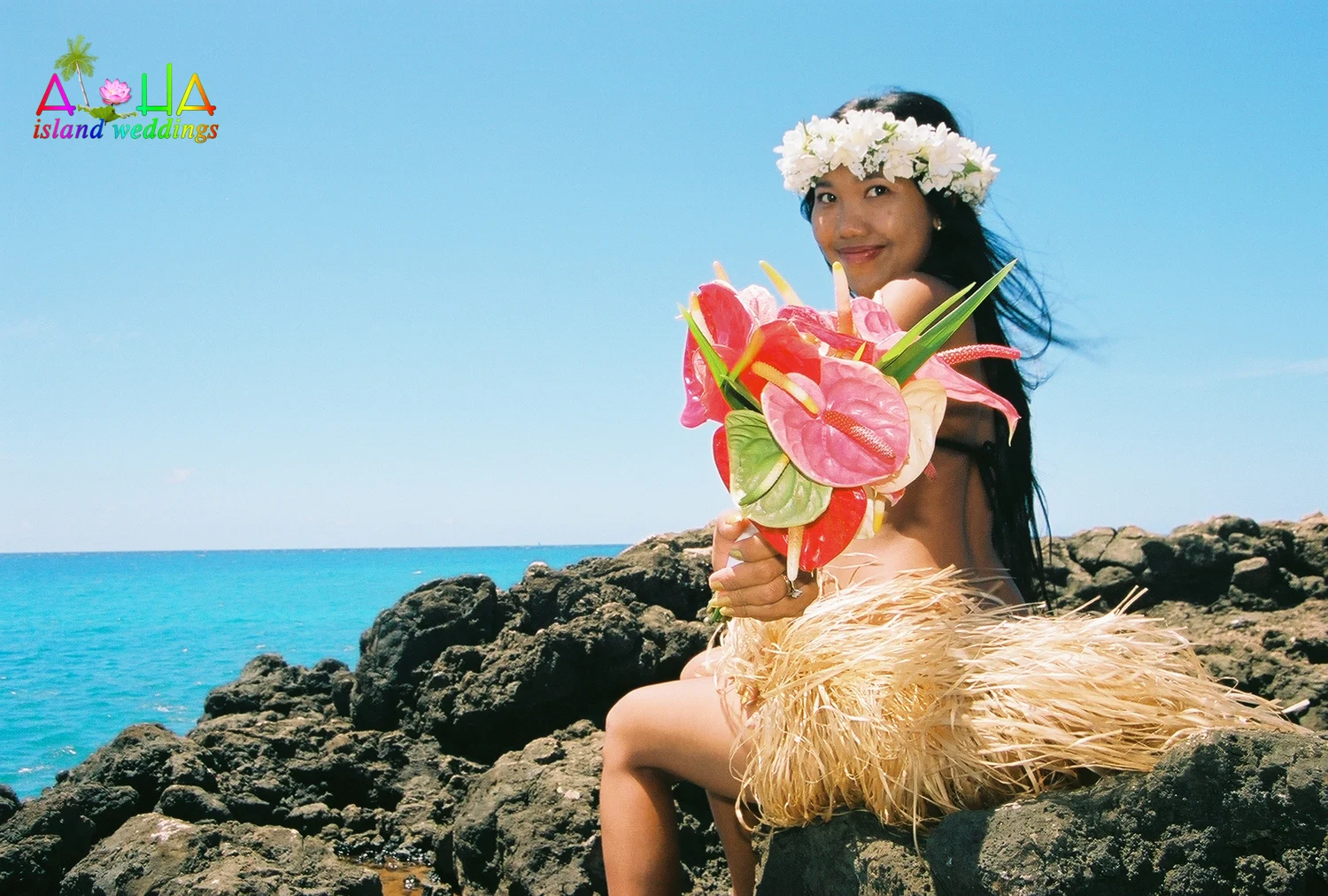
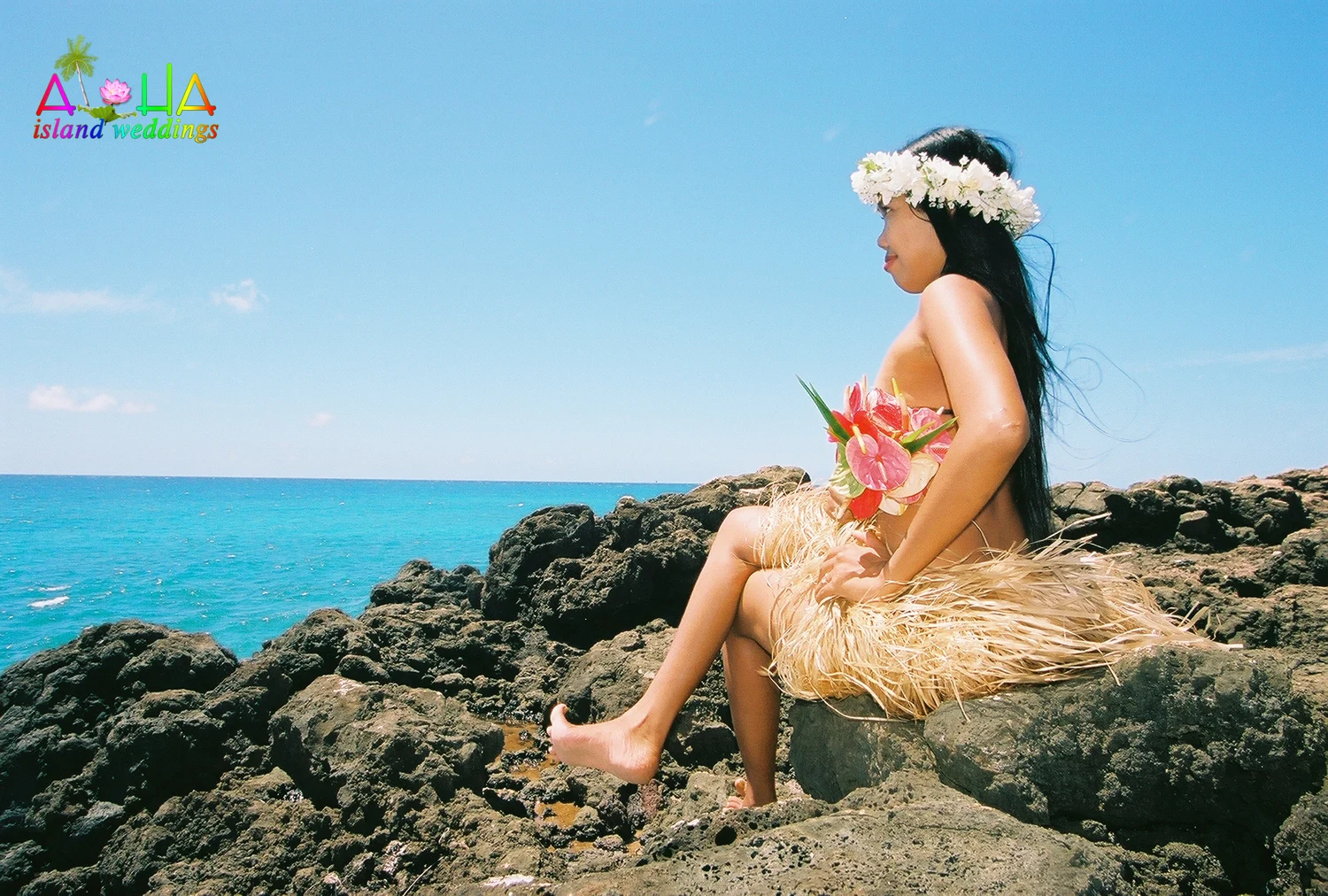
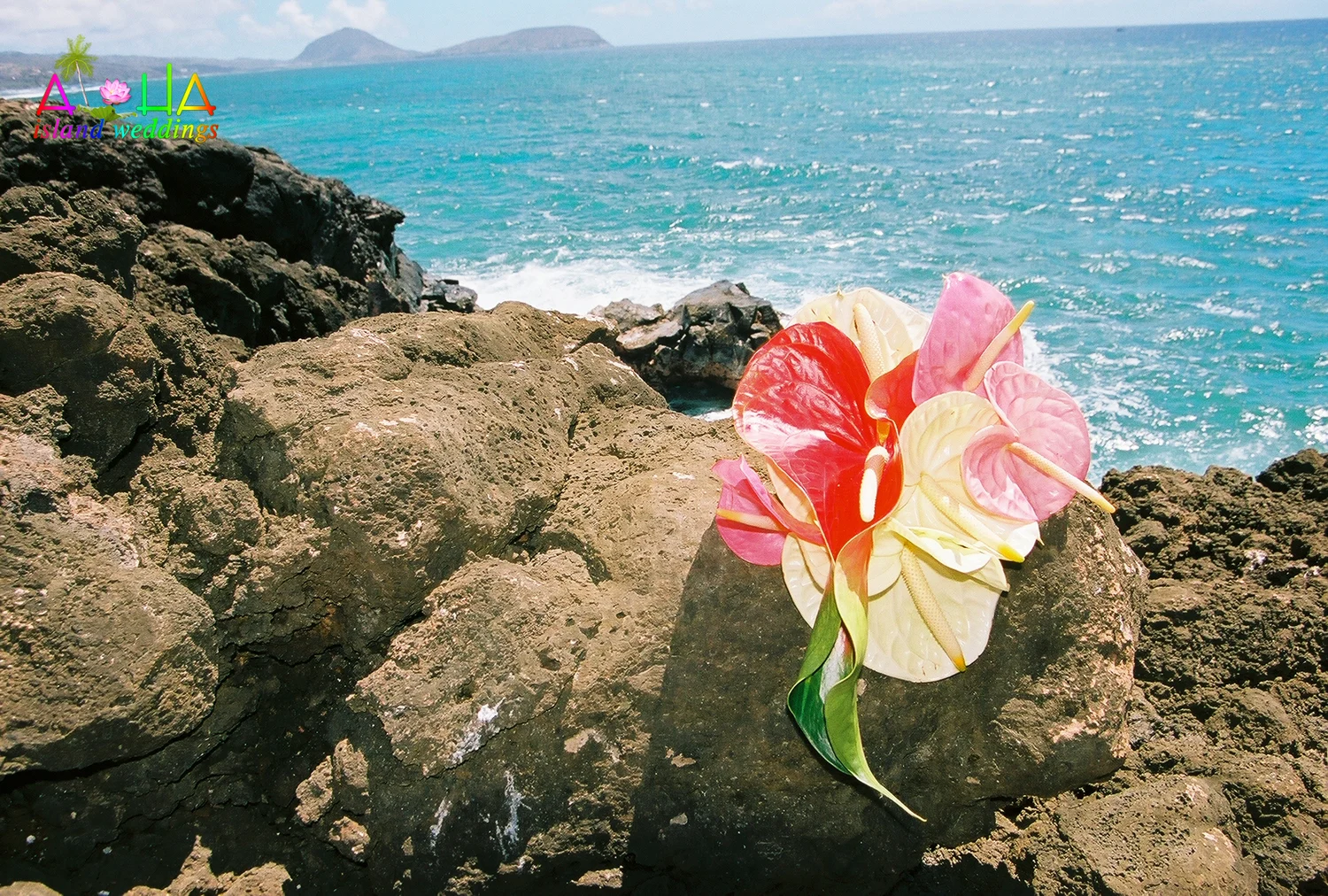
Anthuriums are woven into leis as well. Small anthuriums, often mixed with orchids, ferns and other island flowers, are made into haku leis, the flower crowns worn on the head, so a bride or a hula dancer can wear a whole circle of shining hearts.
The anthurium’s heart shape lives on in Hawaiian art and jewelry too. Island jewelers shape it into pendants, earrings, rings and charms in gold, silver and enamel, and it appears on aloha shirts, quilts and paintings, a keepsake of the islands that never wilts.
Because a cut anthurium keeps its shine for so long, it has also become one of the islands’ favorite gifts to send home: a piece of Hawaiian color that is still bright days after it leaves the islands.
Toxicity
All parts of the plant contain calcium oxalate crystals. The sap can irritate the skin and eyes, and the plant is toxic to cats, dogs and horses, so it should be kept away from pets.[1]
Use in Hawaiian weddings
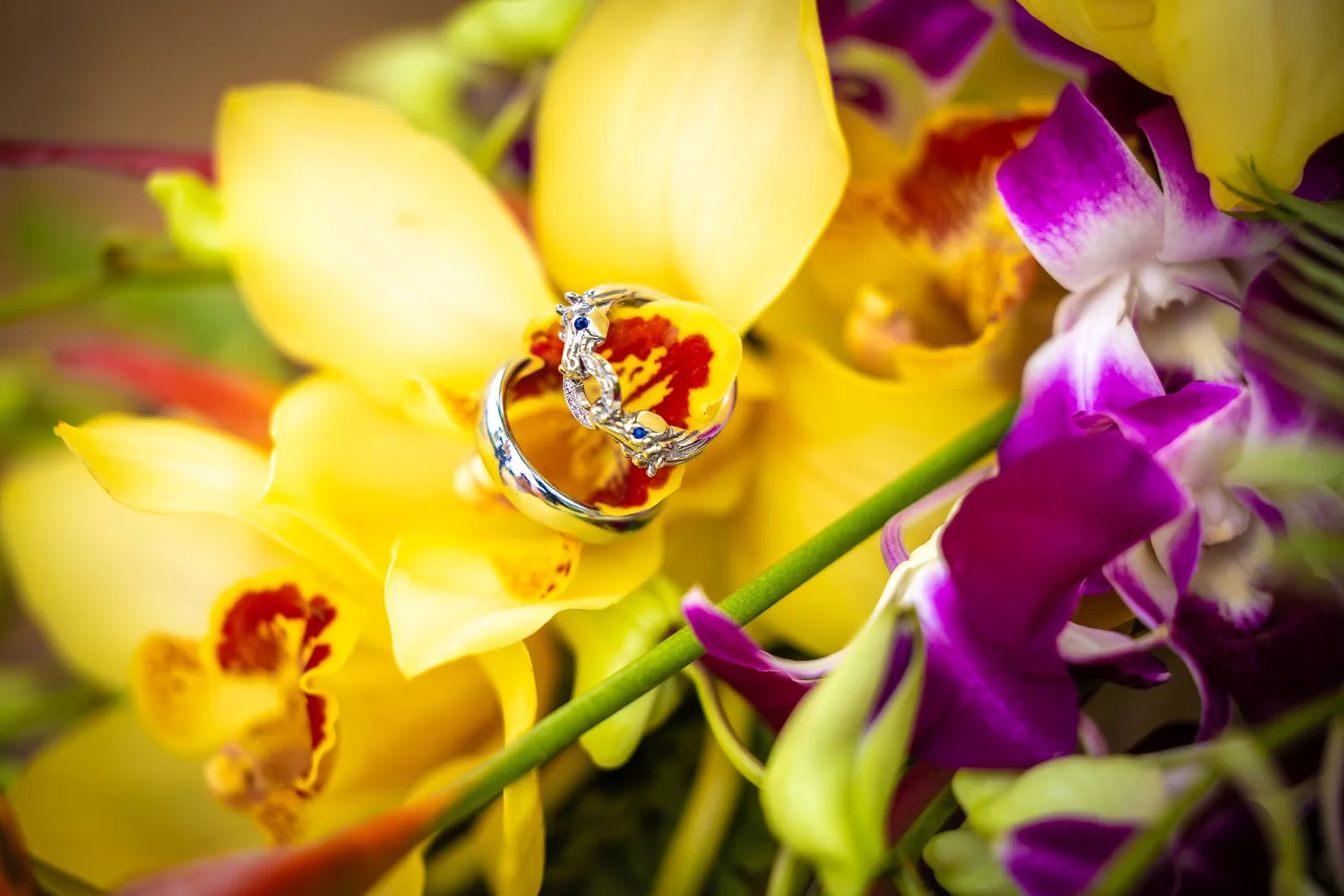
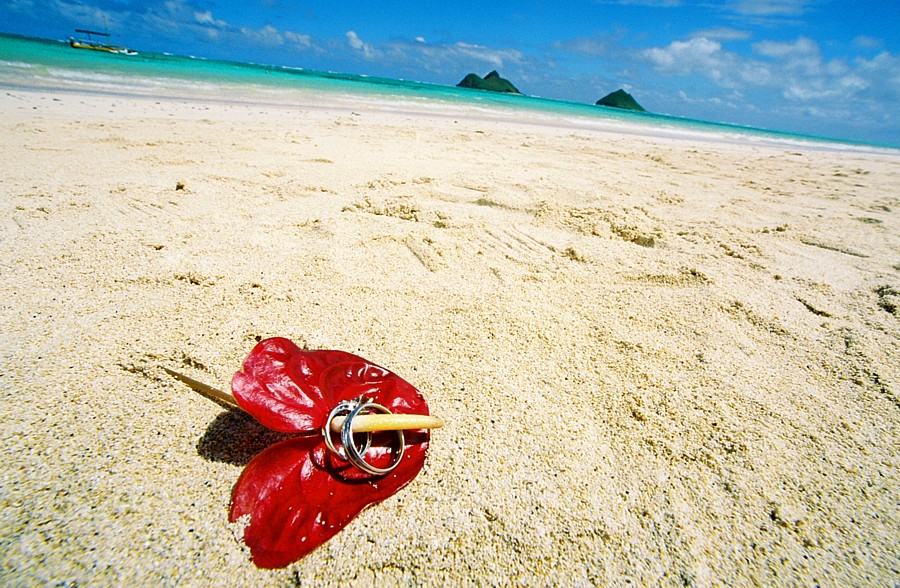
Thick, waxy spathes make anthuriums one of the longest lasting tropical flowers, and they stay fresh through a ceremony in the sun and trade winds. At Aloha Island Weddings we use red anthuriums as a resting place for the rings, green obake anthuriums in turquoise chair sashes along the aisle, and pink anthuriums in tropical bouquets with ginger and orchids.
Anthurium prices
- Anthurium bouquet: $285
- Aisle of anthuriums: $240
- Reception table arrangement with anthuriums and other exotic Hawaiian flowers: $275
All prices are plus 4.712% Hawaii state tax. See all our flower prices, or ask us about anthurium haku leis and matching arch flowers.


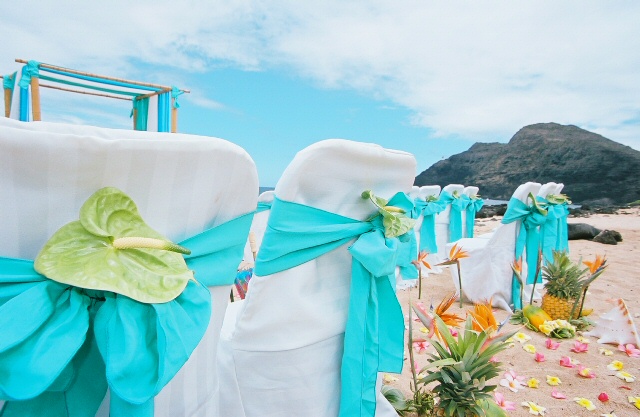
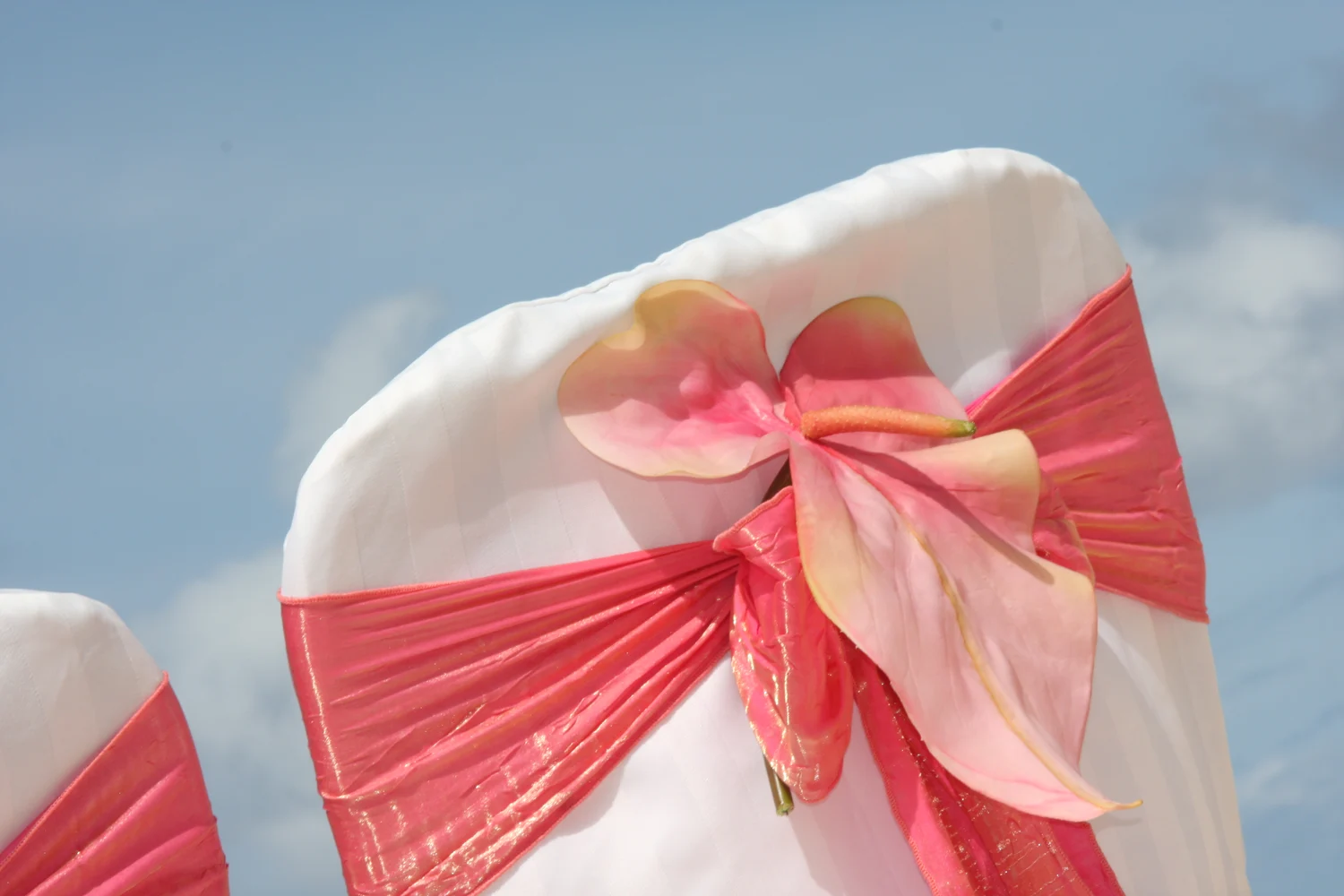
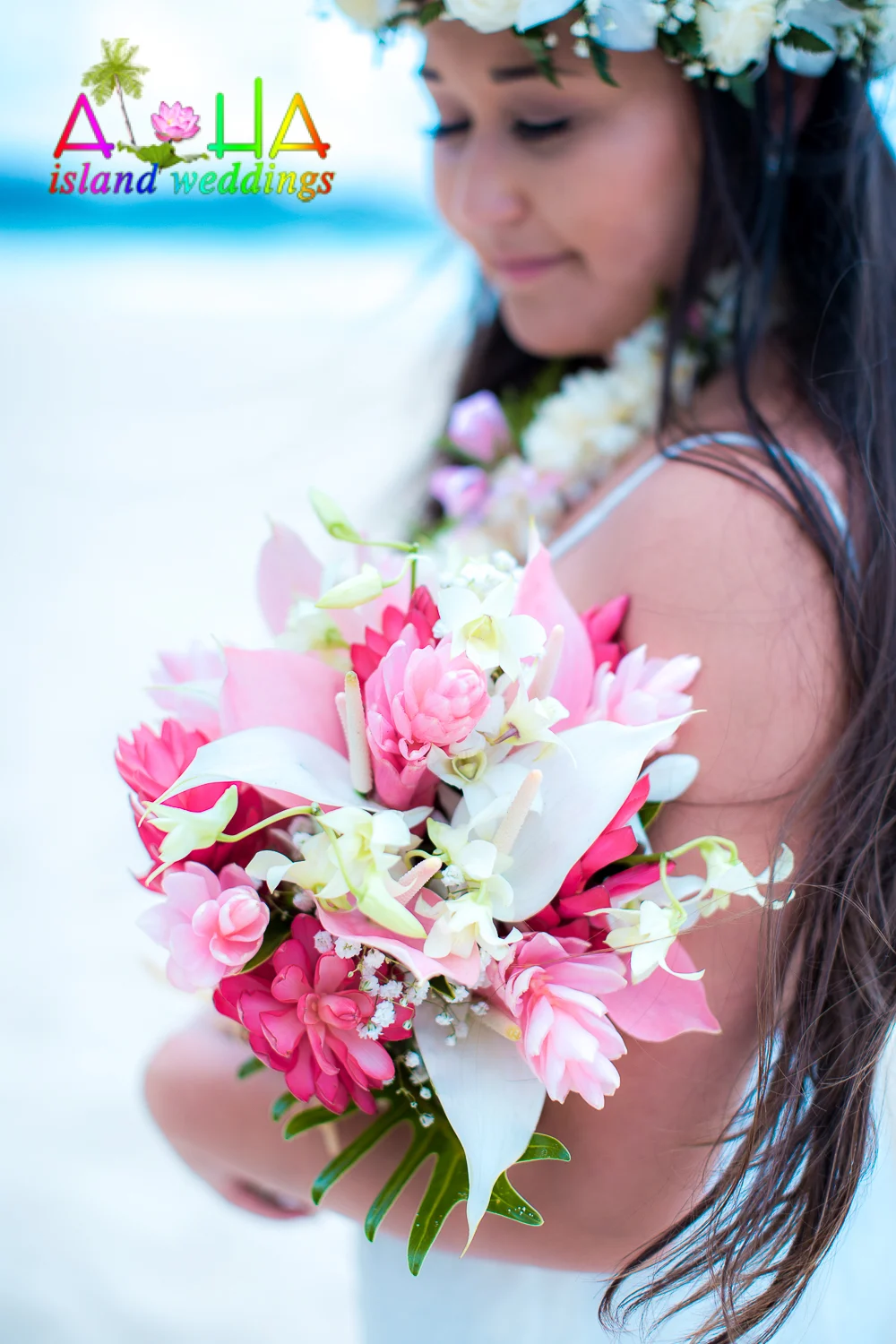

See more on our tropical wedding flowers page, Tami and Albert’s turquoise beach wedding and our bouquets.
Timeline
- 1829: the genus Anthurium is named by the botanist Heinrich Wilhelm Schott[1]
- 1889: Samuel Mills Damon brings the anthurium to Hawaii from London[2]
- 1930s–1940s: growers learn to raise anthuriums from seed; ‘Ozaki’ and other classic varieties appear[4]
- 1950: the University of Hawaiʻi breeding program begins[2]
- 1959: about 266 anthurium farms in Hawaii; Pāhoa is the anthurium capital[2]
- 1981: blight begins killing plants on Hilo farms[2]
- 1985–1989: the blight epidemic; about 200 small farms close[8]
- 1990: harvest down to 15.6 million stems from about 30 million[3]
- 2004: anthuriums are Hawaii’s top cut flower at $4.7 million[3]
Planning a wedding? Our beach wedding packages run from $350 to $8,000 (all packages), plus 4.712% Hawaii state tax. The average Hawaii wedding costs about $53,369, half of couples spend less than $21,117, and our own couples usually spend $10,000 to $15,000 (The Wedding Report; see our Hawaii wedding statistics).
See also
References
- Anthurium. Wikipedia.
- Anthuriums. American Phytopathological Society.
- Rebuilding Hawaii’s anthurium industry (2006). American Phytopathological Society.
- Anthurium Culture in Hawaiʻi. University of Hawaiʻi, CTAHR.
- Breeding Anthuriums in Hawaii (Kamemoto & Kuehnle, 1997). University of Hawaiʻi Press.
- Evaluation and Improvement of Anthurium Clones (Technical Bulletin 58). Hawaii Agricultural Experiment Station.
- New Plants for Hawaii. University of Hawaiʻi, CTAHR.
- Anthurium growers and bacterial blight. Hawaii Tribune-Herald.
- Anthurium blight under control. University of Hawaiʻi, CTAHR.